Table of Contents
The Sleep Apnea Complete Guide covers everything you need to know about sleep apnea, a sleep-related breathing disorder that causes repeated pauses in breathing during sleep. It’s treated with options such as CPAP, oral appliances, lifestyle changes, and, in some cases, surgery or other targeted therapies. This guide explains what it is, why it happens, how it’s diagnosed, and which treatments actually work.
What Is Sleep Apnea?
Sleep apnea is a condition in which breathing repeatedly stops or becomes shallow during sleep, lowering sleep quality and sometimes reducing oxygen levels overnight. Those breathing interruptions can happen dozens of times an hour, which is why many people wake up tired even after what seemed like a full night in bed.
This disorder affects more than snoring alone. Repeated breathing disruptions can strain the heart, disturb normal sleep cycles, and leave people with headaches, dry mouth, brain fog, poor concentration, and daytime sleepiness. In more severe cases, untreated disease is linked with higher risks of high blood pressure, stroke, heart disease, and accidents related to drowsiness.
In clinical practice, diagnosis usually comes from an in-lab sleep study or a home sleep apnea test, depending on symptoms, health history, and how straightforward the case appears. Loud snoring is often the symptom people notice first, but the bigger issue is the repeated drop in restful, restorative sleep — even people who don’t snore loudly can have significant breathing interruptions that a bed partner never hears. Our Sleep Apnea Facts guide covers just how common — and how often undiagnosed — this actually is.
How the Disorder Works
The basic problem is that breathing becomes unstable during sleep either because the upper airway narrows or closes, or because the brain’s breathing signals are not working normally. When airflow drops, the body briefly rouses enough to reopen the airway or restart regular breathing, often without full awareness.
That stop-start cycle can repeat over and over through the night. Instead of moving smoothly through healthy sleep stages, the body keeps getting pulled into partial arousals — one reason people often feel exhausted, irritable, or mentally foggy the next day, despite technically being “asleep” for eight hours.
Types of Sleep Apnea: OSA, CSA, and Complex
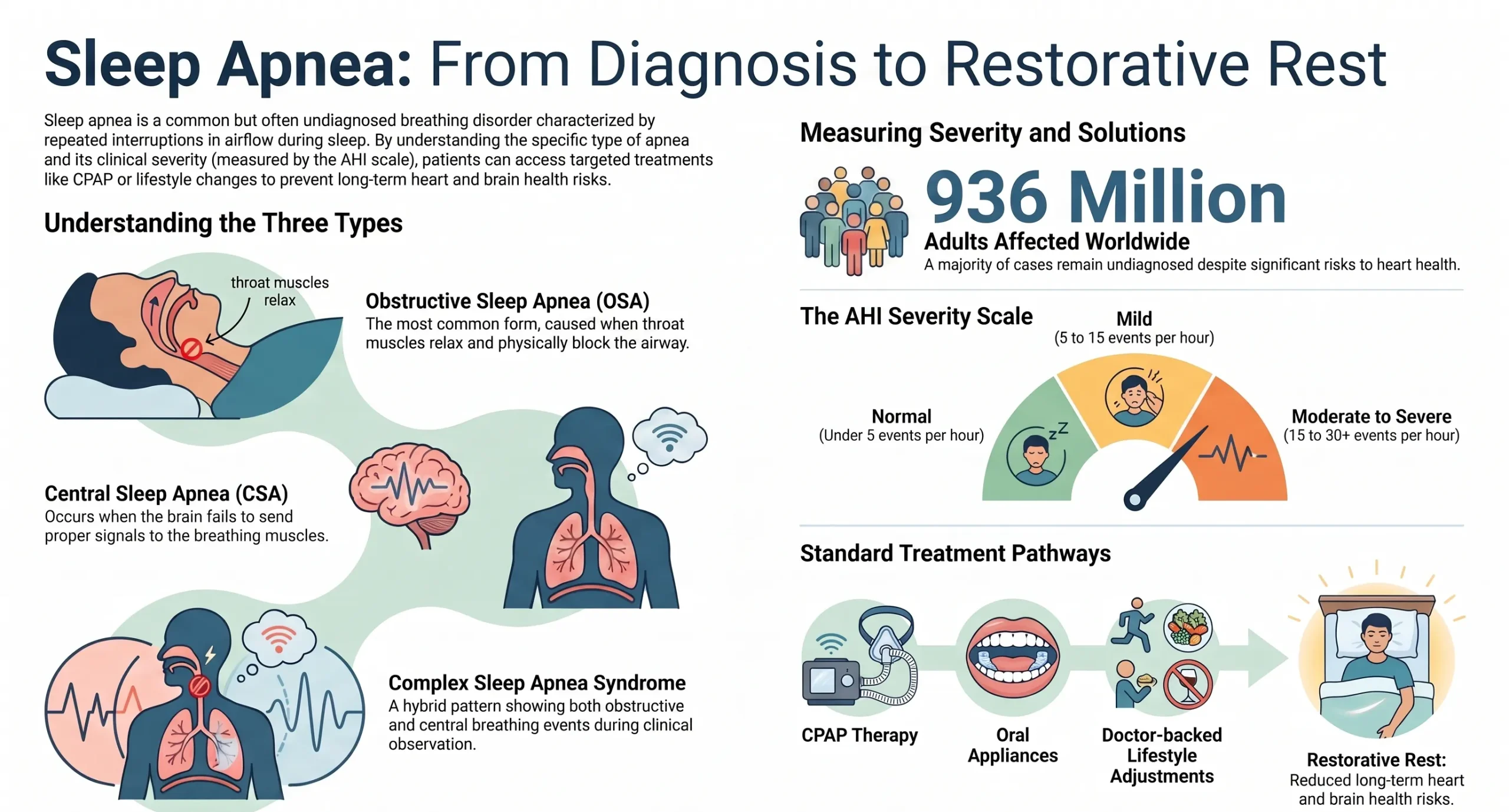
The three main forms are obstructive sleep apnea, central sleep apnea, and complex sleep apnea syndrome, which combines features of both.
Obstructive sleep apnea (OSA) is the form most people mean when they talk about the condition. It usually happens when throat muscles relax during sleep and the airway narrows enough to limit or stop airflow. Risk often rises with excess weight, aging, certain anatomical features, and upper-airway crowding.
Central sleep apnea (CSA) is less common and works differently because the issue is not a blocked throat but an unstable breathing drive. This type may appear alongside certain neurological, cardiac, or medication-related factors, which is why a full clinical evaluation matters.
Complex sleep apnea is diagnosed when a person shows obstructive patterns but also develops or continues to have central breathing events. That does not automatically mean treatment will be difficult, but it does mean the sleep study needs careful interpretation and follow-up.
Type | What happens | Common pattern | Usual next step |
Obstructive | The airway becomes blocked or collapses during sleep. | Often linked with snoring, choking, or gasping. | Confirm severity via AHI score, then match treatment (CPAP, oral appliance, or lifestyle) to symptoms. |
Central | Breathing pauses happen because the brain does not send normal signals to the breathing muscles. | Snoring may be less obvious; underlying heart or neurological issues may matter more. | Identify the underlying cause first — treatment targets that cause, not just the breathing pauses. |
Complex | Obstructive events are present, but central events also appear, often during treatment assessment. | Can look like a mixed pattern on formal sleep testing. | Requires specialist interpretation and often a treatment adjustment partway through therapy. |
Symptoms to Watch For
Sleep apnea symptoms usually appear in two waves — nighttime signs and daytime effects — because the breathing problem happens at night, but the exhaustion it causes builds up during the day. Common nighttime signs include loud snoring, pauses in breathing, choking, gasping, restless sleep, and waking with a dry mouth or sore throat.
Daytime symptoms are just as important. Many people report heavy fatigue, morning headaches, low energy, poor concentration, irritability, and sleepiness during reading, meetings, or driving. Some also notice mouth breathing at night, which can make sleep feel more broken and uncomfortable.
One common mistake is waiting for every textbook symptom to appear before taking the issue seriously. Not everyone snores loudly, and not everyone realizes they are waking repeatedly, so input from a bed partner, wearable trends, or recurring daytime exhaustion can be useful clues before formal testing.
Causes and Risk Factors
The most common drivers include excess body weight, older age, family history, narrowed airways, enlarged tonsils, and structural issues that make nighttime breathing harder. Nasal blockage can also make symptoms worse, and factors such as alcohol use before bed or sleeping on the back may increase airway collapse in some people.
A blocked or crowded airway does not always come from one single cause. In many cases, several smaller issues stack together: anatomy, muscle tone, sleep position, and weight distribution can all play a role. Structural problems such as a deviated septum can also contribute to breathing difficulty during sleep, especially when nasal airflow is already limited.
Understanding the cause matters because the right treatment plan works best when it addresses both the sleep study result and the reason the breathing problem is happening, rather than focusing on one symptom alone.
How Diagnosis Works
Sleep apnea is diagnosed with a sleep evaluation followed by testing that measures breathing interruptions, oxygen levels, airflow, and related sleep data. For many adults with suspected obstructive disease, testing may happen either in a sleep lab or at home using an approved sleep apnea device, depending on the case.
The diagnosis process usually follows these steps:
- A clinician reviews symptoms such as snoring, witnessed breathing pauses, morning headaches, and daytime sleepiness.
- Risk factors and other health conditions are assessed to decide whether home testing is appropriate or whether in-lab monitoring is the better choice.
- The sleep study measures breathing events, and the results help classify the condition as normal, mild, moderate, or severe using the apnea-hypopnea index, or AHI.
A normal AHI is under 5 events per hour, while 5 to 15 is typically considered mild, 15 to 30 moderate, and above 30 severe — the standard classification used by sleep medicine specialists. (American Academy of Sleep Medicine clinical criteria) Wearables can flag trends that suggest poor sleep, but they are not a substitute for a clinical-grade test when a real diagnosis is needed — see our
Apple Watch sleep apnea detection test for exactly where wearables fall short. If nasal obstruction is a suspected contributor,
a simple self-test can help you check for a deviated septum at home before your sleep test.
In this Sleep Apnea Complete Guide, we’ll now explore the most effective treatment options based on the type and severity of the condition.
Treatment Options
Obstructive sleep apnea treatment options include CPAP or other positive airway pressure devices, oral appliances, weight-focused strategies, positional therapy, and selected surgical or specialist approaches. The best option depends on the sleep study results, symptom burden, anatomy, comfort, and whether the condition is obstructive, central, or mixed.
CPAP remains one of the most effective standard treatments, especially for moderate to severe obstructive disease, because it uses steady air pressure to keep the airway open through the night. Many people are apprehensive about starting CPAP, but tolerance improves significantly once mask fit, humidity, and pressure settings are adjusted correctly for the individual.
Oral appliances can help some adults, particularly when disease is mild to moderate or when CPAP cannot be tolerated. These devices are usually designed to move the jaw forward and reduce airway collapse during sleep.
Lifestyle changes are not a replacement in every case, but they can matter. Weight loss, exercise, reduced alcohol intake before bed, and side-sleeping can improve symptoms for some people and are often used alongside device-based care — our 4 doctor-backed lifestyle changes guide covers the research behind each one. Supportive home remedies for sleep apnea may also help with comfort and routine, but they should not replace evidence-based treatment when breathing interruptions are frequent or severe.
Surgery or other advanced treatment pathways may be considered when anatomy is a major issue or when standard therapy is not effective enough. Central or complex cases may require a different strategy entirely, which is why matching treatment to the actual sleep-study pattern matters more than guessing from symptoms alone.
Risks of Leaving It Untreated
Untreated sleep apnea can raise the risk of high blood pressure, heart disease, stroke, daytime accidents, and ongoing decline in energy, concentration, and mood. We cover the real risks of leaving sleep apnea untreated in more detail in a dedicated guide. It can also affect partners and households because fragmented sleep, loud snoring, and nighttime awakenings rarely impact just one person.
The danger is not always dramatic in the short term, which is why many people put off testing. Over time, though, repeated oxygen drops and sleep disruption can place real strain on the cardiovascular system and make everyday functioning noticeably worse. That’s why clinicians take persistent symptoms seriously even when a person has learned to “live with it.”
Common Mistakes People Make
- Assuming snoring alone confirms the diagnosis. Snoring is a frequent sign, but diagnosis requires proper testing — not everyone who snores has sleep apnea, and not everyone with the disorder snores audibly.
- Treating fatigue as normal aging, stress, or a busy schedule. When heavy daytime sleepiness keeps showing up alongside headaches, dry mouth, or witnessed breathing pauses, those patterns deserve a real sleep evaluation rather than being dismissed.
- Searching only for a cure and ignoring manageable treatment paths. Many people do very well once they find the right combination of mask style, pressure settings, oral device support, or lifestyle changes that fit their actual condition.
Key Facts and Statistics
Sleep apnea affects an estimated 936 million adults worldwide, with a majority of cases remaining undiagnosed. (Benjafield et al., 2019, The Lancet Respiratory Medicine) That gap matters because treatment cannot start until the condition is recognized, tested, and matched with a plan a person can realistically stick with over time.
AHI categories help explain severity clearly: under 5 events per hour is normal, 5 to 15 is mild, 15 to 30 is moderate, and above 30 is severe. (AASM clinical criteria) For readers who want the full picture on why this condition is so often missed, our 9 Sleep Apnea Facts guide breaks down the numbers most people have never heard.
This Sleep Apnea Complete Guide has covered the symptoms, causes, diagnosis, and treatment options to help you better understand the condition before exploring the most common questions below.
FAQ's
What is sleep apnea?
Sleep apnea is a disorder in which breathing repeatedly stops or becomes very shallow during sleep. These interruptions can lower sleep quality, reduce oxygen levels, and leave a person waking unrefreshed even after enough time in bed. The condition is often associated with snoring, choking, gasping, morning headaches, and daytime fatigue, but proper diagnosis still requires clinical testing rather than symptoms alone.
What are the 3 types of sleep apnea?
The three types are obstructive sleep apnea, central sleep apnea, and complex sleep apnea. Obstructive sleep apnea happens when the airway narrows or collapses during sleep, central sleep apnea happens when breathing signals are disrupted, and complex sleep apnea includes both patterns. Distinguishing between them matters because the treatment approach should match the pattern found in the sleep study.
What are the most common symptoms?
The most common symptoms are loud snoring, witnessed breathing pauses, choking or gasping during sleep, morning headaches, dry mouth, and excessive daytime sleepiness. Some people also notice poor concentration, irritability, low energy, or the feeling that they slept long enough but never actually rested. Bed-partner observations can be especially helpful because many nighttime signs happen without the sleeper fully noticing them.
What causes sleep apnea?
Common causes include excess weight, narrowed airways, upper-airway crowding, aging-related loss of muscle tone, enlarged tonsils, and structural breathing issues. Alcohol before bed, certain anatomical features, and sleeping position may also make obstructive events worse for some people. In central cases, the cause relates more to breathing control than to physical blockage, so the underlying pattern matters.
How is sleep apnea diagnosed?
Sleep apnea is diagnosed with a sleep study, either in a laboratory or through an approved home sleep apnea test when appropriate. The test measures breathing interruptions, airflow, oxygen levels, and related sleep data, then uses those results to classify severity. The final interpretation should come from a qualified clinician because the same symptom can point to different breathing patterns or treatment needs.
What is a normal AHI score?
A normal AHI score is under 5 breathing events per hour. In general, 5 to 15 is mild, 15 to 30 is moderate, and above 30 is severe. This number helps clinicians describe how often breathing is disrupted during sleep, but treatment decisions also depend on symptoms, oxygen changes, and the broader medical picture rather than the score alone.
What is the best treatment?
CPAP is one of the most effective standard treatments for moderate to severe obstructive disease. It works by using pressurized air to keep the airway open during sleep. That said, the best treatment for an individual person may also involve oral appliances, positional therapy, weight-focused care, or other specialist options depending on the sleep study results and treatment tolerance.
Can sleep apnea be cured?
Sleep apnea is sometimes improved or resolved when a reversible cause is addressed, but many people manage it as an ongoing condition rather than a one-time fix. Weight loss, anatomical treatment, or targeted therapy can make a meaningful difference in some cases. The practical goal is to reduce breathing interruptions, improve sleep quality, and lower health risk with a plan that works long term.
Sleep Apnea Complete Guide: Key Takeaways
This Sleep Apnea Complete Guide has explained what sleep apnea is, its symptoms, causes, diagnosis, and the most effective treatment options available. Early diagnosis and the right treatment plan can improve sleep quality, reduce long-term health risks, and help you enjoy better overall well-being. If you’re ready to begin or improve your therapy, explore the recommended CPAP machines, masks, and supplies below to support your treatment journey.
Ready to Start or Improve Your Treatment?
If a diagnosed sleep breathing disorder is affecting your sleep quality, consistency with therapy matters more than buying equipment at random. As explained throughout this Sleep Apnea Complete Guide, CPAP users generally do better when they choose the right mask type for their breathing pattern, replace worn supplies on a regular schedule, and build a nightly routine they can actually stick with.
cpapRX carries CPAP machines, a full range of mask styles (full face, nasal, and nasal pillow), and replacement supplies to support an established treatment plan — browse the full range to find what fits your therapy. If you haven’t been tested yet, an at-home sleep test is the fastest way to find out where you stand.
Resources & Further Reading
- NHLBI – Sleep Apnea Treatment
- NHS – Sleep Apnoea Overview
- NCBI Bookshelf – Obstructive Sleep Apnea
- PubMed – Global Prevalence of OSA (Benjafield et al., 2019)
- PubMed – AASM Clinical Criteria for Sleep Apnea Severity
Medical Disclaimer
Disclaimer: This content is for informational purposes only and is not medical advice. Always consult a qualified healthcare provider for diagnosis and treatment of sleep apnea.