Table of Contents
Why are CPAP batteries necessary? They keep CPAP therapy running during power outages, travel, camping, and emergencies — most portable batteries provide up to 13 hours of backup power, so sleep apnea treatment doesn’t stop just because wall power isn’t available.
Overview
A CPAP battery is a backup power source that lets your CPAP machine keep running when normal electricity isn’t available. For people who depend on CPAP therapy, that means fewer missed nights and more reliable sleep anywhere — at home, on the road, or off the grid.
Consistency matters because sleep apnea therapy only works when it’s used every night, not just when it’s convenient. If you’re newer to treatment or still learning how the condition and its treatments fit together, our sleep apnea complete guide covers symptoms, causes, diagnosis, and every treatment option in full — useful context for understanding why an uninterrupted night matters as much as the therapy itself.
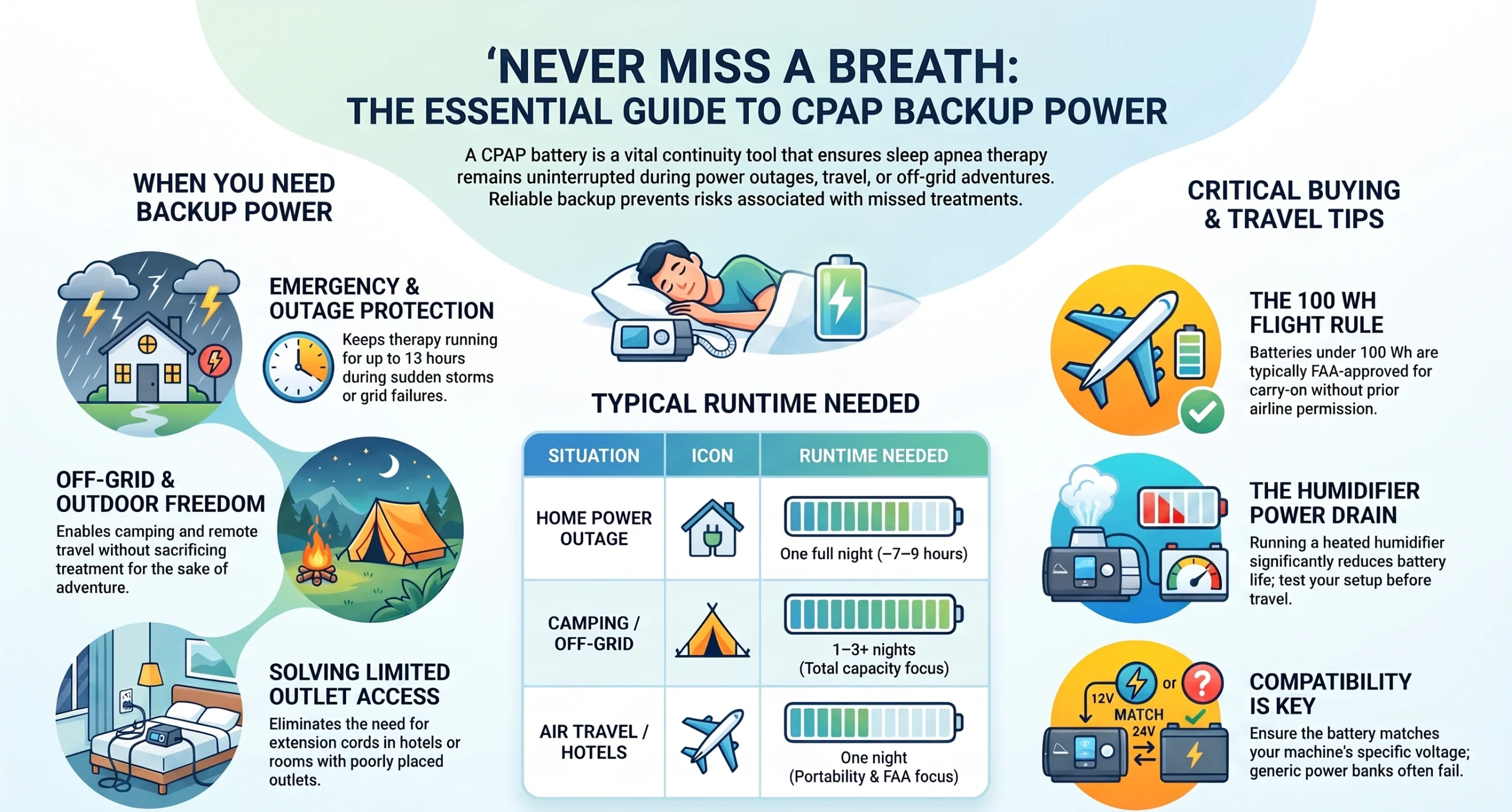
This is exactly why CPAP batteries are necessary for anyone who treats a single missed night seriously: a blackout, a road trip, an off-grid campsite, or a hotel room with an inconveniently placed outlet can all interrupt therapy without one. Once you understand the six situations below, it becomes clear that a battery is a continuity tool for treatment, not just an accessory.
1. Power Outages — Keep Breathing When the Lights Go Out
The most obvious reason is a sudden power outage. If electricity goes out mid-sleep, a CPAP battery keeps therapy going instead of forcing you to sleep without treatment.
This matters most for people in areas with storms, unstable grids, or frequent blackouts. According to ResMed, external CPAP batteries can provide up to 13 hours of power on a full charge — typically enough for a full night, though runtime drops noticeably if you run the heated humidifier at the same time. A battery turns a stressful blackout into a manageable night instead of a missed treatment.
2. Camping Trips — Don’t Choose Between the Outdoors and Therapy
Camping is another major reason batteries are necessary. Campsites don’t always have reliable power, and some off-grid locations have no outlet at all, which makes a CPAP power outage camping solution essential for uninterrupted therapy.
A portable battery lets you sleep outdoors without choosing between sleep apnea treatment and the trip itself. This is one of the most common use cases patients ask about, because it removes the tradeoff between staying on therapy and enjoying time away from reliable outlets.
3. Travel Days — Never Depend on a Hotel Outlet Again
Travel often creates power problems even in hotels, airports, or short-stay rentals. A portable CPAP power bank travel setup helps when outlets are far from the bed, when you’re moving between locations, or when you want a simple backup in case the room power fails.
This is also useful on long transit days where keeping your therapy organized matters. Instead of depending on every stop having the right outlet, a battery gives you a reliable fallback wherever you sleep. If you’re flying, check your airline’s lithium battery watt-hour limit before packing it — most CPAP batteries fall well within standard carry-on limits, but it’s worth confirming for your specific model.
4. Emergency Backup — Your First Line of Defense
A CPAP battery is also valuable in emergencies beyond ordinary blackouts. Weather events, utility failures, or disaster situations can last longer than one night, and a battery gives you a first layer of protection while you figure out the next step.
That matters because CPAP therapy isn’t optional for many users who feel much worse without it. A backup battery reduces stress, keeps your routine more stable, and helps you stay prepared instead of reacting at the last minute.
5. Limited Outlet Access — Stop Fighting for One Plug
Sometimes the problem isn’t a power failure but a bad outlet setup. Hotel rooms, guest rooms, RVs, and temporary accommodations can have outlets that are too far from the bed or shared with other devices.
A battery solves that convenience problem by giving you portable power on your own terms — no rearranging the room, searching for extension cords, or compromising comfort just to keep your machine running.
6. Peace of Mind — Sleep Without the “What If”
The sixth reason is just as real as the first five, even though it’s less about a specific event: knowing you have backup power changes how you sleep. If you worry about interruptions or rely on CPAP every single night, that background stress is itself worth solving.
Many people look into backup power only after their first bad night — a missed treatment during travel, or a blackout that caught them unprepared. Setting it up in advance means one storm, one trip, or one bad outlet doesn’t have to interrupt therapy at all.
Which Situation Applies to You? Find Your Match in Seconds
Situation | What Matters Most | Runtime You’ll Typically Need |
Power outage at home | Reliable output, quick setup | One full night (~7-9 hrs) |
Camping / off-grid | Total capacity, no recharge access | 1-3+ nights depending on trip length |
Air travel | Compact size, airline battery limits | One night, occasional backup |
Hotel / limited outlets | Portability, easy packing | One night |
Emergency / disaster prep | Maximum capacity, durability | Multiple nights, worst-case planning |
Flying With a CPAP Battery? Know the Airline Rules First
Lithium-ion batteries — the type used in nearly all portable CPAP batteries — are regulated by the FAA for air travel. According to the FAA, here’s the exact rule:
Battery Rating | Airline Rule |
Up to 100 Wh | Allowed in carry-on without airline approval — covers nearly all CPAP batteries |
101–160 Wh | Allowed only with airline approval, max 2 spare batteries |
Over 160 Wh | Not permitted on passenger aircraft |
Most portable CPAP batteries fall well under the 100 Wh threshold, so they’re carry-on friendly without needing prior airline approval — but always check the Wh rating printed on your specific battery before you fly, since capacity varies by model.
How to Choose the Best CPAP Battery — Without Guessing
Not every battery works the same way, so it helps to think about runtime, compatibility, portability, and charging speed. The best CPAP battery backup for 2026 isn’t a single model — it’s the one that matches your specific use case from the table above.
If you travel often, prioritize a compact unit that’s easy to pack and recharge between trips. If you camp or prepare for outages, total capacity and reliable output under load matter more than size. Always confirm the battery is rated to handle your specific CPAP machine’s power draw, especially if you use a heated humidifier — humidifier use can cut runtime significantly compared to the machine running alone.
Common Mistakes — And How to Avoid Them
- Buying without checking CPAP compatibility. Not every battery outputs the right voltage or connector type for every machine — confirm compatibility with your specific model before buying.
- Assuming any power bank runs a full night. General-purpose power banks are often not rated for the sustained draw a CPAP motor and humidifier require, even if the listed capacity sounds high enough on paper.
- Running the humidifier without accounting for reduced runtime. Heated humidification is one of the biggest drains on battery life — if you’re planning for a full night away from power, test with the humidifier on, not off.
- Never testing the battery before you need it. It’s far better to learn your actual runtime at home than to discover a shortfall during a blackout or halfway through a trip.
FAQ's
Why are CPAP batteries necessary?
CPAP batteries are necessary because they keep therapy running when regular electricity is unavailable — during outages, camping, travel, and emergencies. For people who rely on CPAP every night, a battery helps prevent missed treatment and gives them more control over sleep wherever they are.
Do CPAP batteries help during a power outage?
Yes. A CPAP battery provides temporary backup power so therapy can continue through the night instead of stopping when the grid goes down. This is one of the most common reasons users keep one ready at home.
Can I use a CPAP battery for camping?
Yes, as long as the battery is compatible with your machine and has enough capacity for your sleep time. It’s a practical way to stay on therapy in tents, cabins, RVs, or remote areas where outlets are limited or unavailable.
What is the best CPAP battery for backup power?
The best choice depends on your use case: compact and lightweight for travel, higher-capacity for camping or multi-night emergencies. Match the battery to the situation in the comparison table above rather than picking by price or brand alone.
Is a portable power bank travel-friendly for CPAP use?
Yes, when it’s compact, easy to carry, and compatible with your machine. It’s especially helpful for hotel stays, road trips, and flights where access to power may be inconsistent or inconvenient — just confirm your airline’s battery watt-hour limit before flying.
How long does a CPAP battery last?
Most portable CPAP batteries provide up to 13 hours of runtime on a full charge without a humidifier, based on ResMed’s published specifications. Actual runtime varies by machine, pressure settings, and whether the humidifier is running, so it’s worth testing your specific setup before relying on it.
Do I still need a battery if I travel only sometimes?
Yes. Unexpected power issues happen at home and on the road, not just for frequent travelers. A battery is useful whenever you want backup protection and confidence that your therapy will continue as planned.
What should I check before buying a CPAP battery?
Check compatibility with your exact machine, real-world runtime with your pressure settings, charging speed, size, and whether it supports your setup with the humidifier running. Reviewing the situation-based comparison above will help you match capacity to your actual needs, whether that’s home backup, travel, or camping.
Conclusion
So, why are CPAP batteries necessary? Because sleep apnea treatment doesn’t pause for a storm, a campsite, or a hotel room with the outlet in the wrong place—and a reliable backup battery means it doesn’t have to. Whether you’re planning for outages, travel, or simply want peace of mind, matching the right battery to your situation keeps your therapy consistent no matter where you sleep.
Ready to Add Backup Power to Your CPAP Setup?
If tonight’s blackout, next month’s camping trip, or your next flight has you thinking about backup power, don’t wait until you actually need it to find out your setup falls short.
cpapRX carries CPAP-compatible batteries and travel accessories built to work with your specific machine — not generic power banks that may not handle a CPAP motor’s actual power draw. Browse our CPAP batteries to find a battery matched to your machine, your humidifier use, and how you actually plan to use it, whether that’s one emergency night at home or a full week off-grid.
Every order ships free over $100, and CPAP batteries are typically FSA/HSA eligible — so backup power for your therapy is easier to justify than it might seem.
Resources & Further Reading
- ResMed: CPAP Batteries and Adaptors
- NHLBI: Sleep Apnea Treatment
- Sleep Foundation: Best CPAP Batteries of 2026
- PMC: Obstructive Sleep Apnea Diagnosis and Management
Medical Disclaimer
Disclaimer: This content is for informational purposes only and is not medical advice. Always confirm battery compatibility with your specific CPAP machine’s manufacturer before relying on any backup power source.