Table of Contents
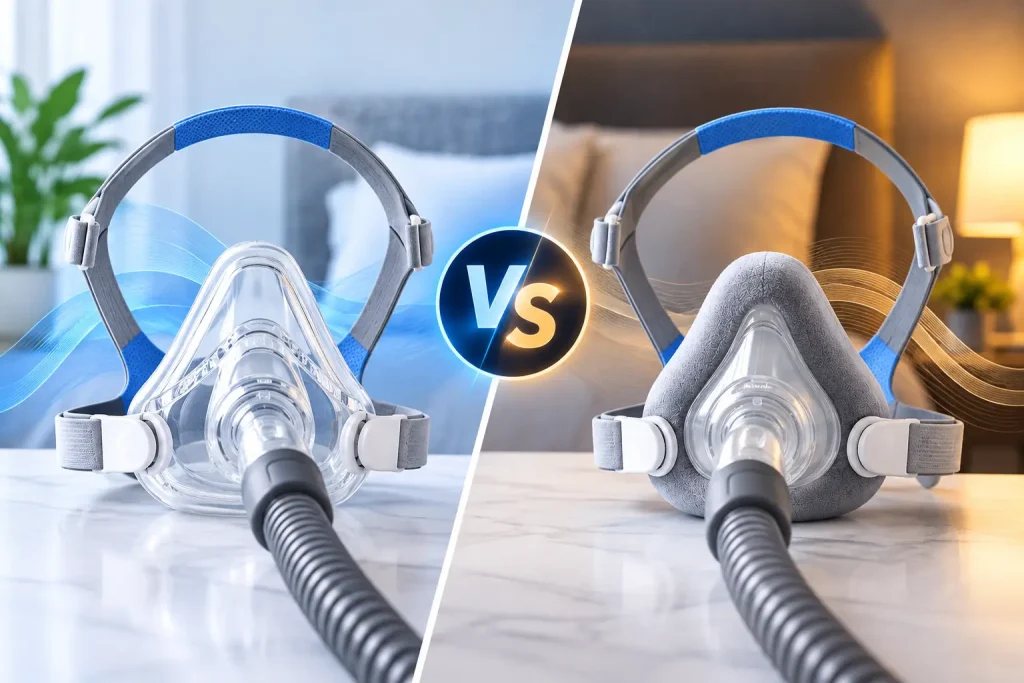
The ResMed AirFit vs AirTouch decision comes down to one thing: cushion material. AirFit uses firm, durable silicone (InfinitySeal); AirTouch uses UltraSoft memory foam or ComfiSoft fabric for a softer, adaptive seal. Choose AirTouch for plush comfort and sensitive skin, or AirFit for easy washing, durability, and lower long-term cost.
Because both lines share the same frames and headgear, you can often swap cushions on the same mask — so the real question isn’t which mask, but which cushion feel suits your skin, cleaning habits, and budget. This guide breaks down the differences by material, comfort, cleaning, cost, and model, so you can pick with confidence.
Still deciding between mask styles first? Start with our guide to full face vs nasal vs nasal pillow CPAP masks, then come back here to choose your cushion material.
ResMed AirFit vs AirTouch at a glance
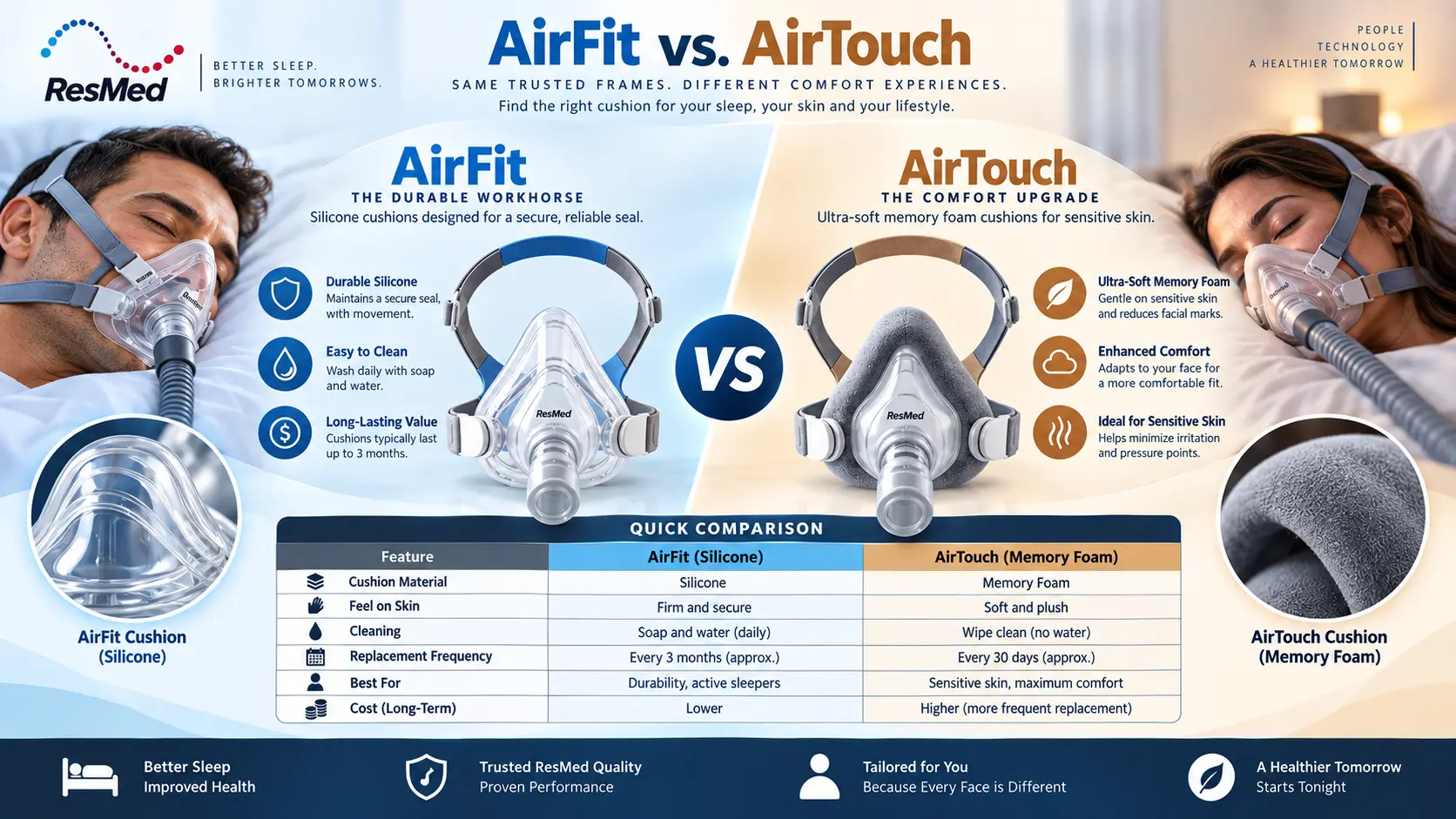
Before the detail, here’s the whole decision in one view:
Factor | AirFit (silicone) | AirTouch (memory foam / fabric) |
Cushion material | InfinitySeal silicone — firm, smooth | UltraSoft memory foam / ComfiSoft fabric — plush |
Feel | Secure, clinical seal | Cloud-like, conforms to your face |
Skin sensitivity | Can leave pressure marks | Reduces red marks and irritation |
Cleaning | Fully washable with soap and water | Wipe-only (foam); fabric washes gently |
Replacement | About every 3 months | About every 30 days |
Long-term cost | Lower (lasts longer) | Higher (frequent replacement) |
Best for | Durability, hygiene, oily skin, value | Comfort, sensitive skin, claustrophobia |
Use this as your shortlist, then read on for the “why” behind each row.
Cushion material and feel: silicone vs memory foam
The core difference is the cushion. AirFit masks use a silicone cushion that’s firm, smooth, and built for long-term durability. AirTouch masks use UltraSoft memory foam (on the F20 and N20) or ComfiSoft fabric (on the N30i) that conforms to your facial contours for a gentle, adaptive seal.
Silicone gives a consistent, reliable seal and is easy to wash. Memory foam adapts quickly to irregular face shapes and reduces pressure marks, which helps if you feel claustrophobic or have sensitive skin. The ComfiSoft fabric on the AirTouch N30i adds breathability while keeping a stable under-nose seal.
In short: silicone is the dependable workhorse; memory foam is the comfort upgrade. Neither is “better” — they solve different problems.
Cleaning and replacement: the daily reality
Cleaning routines differ significantly, and this trips up a lot of new users. AirFit silicone cushions can be fully washed with mild soap and water every day, which many people prefer for hygiene. AirTouch memory foam cushions are wipe-only — washing them with water damages the foam and ruins the seal. The AirTouch N30i fabric cushion is more forgiving and can be gently washed, but still needs careful handling.
Replacement schedules vary too. ResMed recommends replacing AirTouch memory foam cushions about every 30 days as the foam wears. AirFit silicone cushions typically last around three months with proper care. So if you want low-maintenance and infrequent replacements, AirFit wins on practicality.
The cost difference over time (what most guides skip)
Here’s the factor buyers underestimate: memory foam’s comfort comes with a recurring cost. Because AirTouch cushions are replaced roughly monthly and AirFit silicone lasts about three times longer, AirTouch usually costs noticeably more per year in replacement cushions.
That doesn’t make AirTouch a bad choice — for sensitive skin or claustrophobia, the comfort is worth it to many people. But if budget matters and your skin tolerates silicone well, AirFit gives better long-term value. A simple way to decide: pay for comfort you genuinely need, not comfort you could live without.
Swap cushions on the same frame: try before you commit
This is the underrated advantage. ResMed designs AirFit and AirTouch frames to be largely cross-compatible within the same mask style. For example, an AirTouch F20 frame works with an AirFit F20 silicone cushion, and vice versa.
That means you don’t have to gamble on a whole new mask to test a material. Start with the cushion that matches your priority — comfort or durability — then swap just the cushion if it isn’t right. This modular design lets you find your best seal with minimal cost and trial-and-error. If you’re unsure which feel suits your face, this is the smartest, cheapest way to test both.
ResMed mask lines compared by style
Both material families come in the main mask styles, so your breathing route still guides the frame while material guides the feel.
Full face masks: AirFit F20 vs AirTouch F20
Full face masks cover the nose and mouth, making them the top pick for mouth breathers and users with congestion. The AirTouch F20’s memory foam adapts to your face, reducing pressure points and easing claustrophobia, and it seals well even at high pressures. The AirFit F20 uses a silicone InfinitySeal cushion for a durable, consistent seal that’s easy to clean — ideal if you prefer thorough washing, have oily skin, or want longer cushion life.
Nasal masks: AirFit N20 vs AirTouch N20
Nasal masks cover only the nose for a lighter, less claustrophobic feel. The AirTouch N20’s memory foam gently conforms to the nose bridge and sides, helping side sleepers and those with facial hair or sensitive skin. The AirFit N20’s silicone InfinitySeal gives a stable, long-lasting seal that’s fully washable and lower-maintenance. Both suit steady nose breathers on moderate pressures.
Minimal-contact options: AirTouch N30i and AirFit P10
For the least facial contact, the AirTouch N30i wraps the frame in ComfiSoft fabric with a soft under-nose cushion, leaving the bridge free for glasses and reading — great for active sleepers. The AirFit P10 is an ultra-light nasal pillow mask with silicone inserts at the nostrils, ideal for stomach sleepers and anyone who feels confined by larger masks.
Which ResMed mask is right for you?
The ResMed AirFit vs AirTouch choice gets simple once you match it to your situation below:
If you have sensitive skin or get pressure marks — AirTouch memory foam reduces red marks and irritation better than silicone.
If you want the easiest cleaning and best value — AirFit silicone washes daily and lasts longer, keeping ongoing costs down.
If you feel claustrophobic — start with the AirTouch N30i or AirFit P10 for minimal contact; if you need full face, the AirTouch F20’s foam feels less confining.
If you breathe through your mouth — a full face AirFit F20 or AirTouch F20 seals both airways most reliably.
If you use high pressure settings — both lines seal well; AirTouch F20 is noted for a light, breathable seal at high pressures, while AirFit silicone offers firm, dependable stability.
If you’re not sure — buy one frame and try both cushion types on it before committing to a favourite.
The honest verdict
The ResMed AirFit vs AirTouch verdict is simpler than it looks. If comfort is your top priority and your budget allows the monthly cushions, AirTouch’s memory foam feels genuinely plush and is a relief for sensitive skin. If you want a dependable, washable, longer-lasting mask at a lower running cost, AirFit is the practical long-term pick most people stick with. The truest rule still applies: the best ResMed mask is the one that seals comfortably and that you’ll actually wear every night.
Not sure your prescription or fit is right? A cpapRX sleep specialist can help — start your consultation to get guidance before you buy.
FAQ's
What is the main difference between ResMed AirFit and AirTouch cushions?
The main difference is the cushion material. AirFit uses firm, durable silicone (InfinitySeal) that’s fully washable and long-lasting, while AirTouch uses UltraSoft memory foam or ComfiSoft fabric that’s softer and gentler on skin but wipe-only and replaced more often. Both share frames, so you can swap cushions on one mask.
What’s the difference between silicone and memory foam CPAP mask cushions?
Silicone cushions give a firm, consistent, washable seal and last longer, making them cost-effective. Memory foam cushions conform to your face for a plush feel that reduces pressure marks and skin irritation, but they can’t be washed with water and wear out faster. Silicone suits durability and hygiene; foam suits comfort and sensitive skin.
Which ResMed mask is more comfortable for long-term therapy?
AirTouch memory foam is often more comfortable for sensitive skin and claustrophobic users because it conforms softly and reduces red marks. However, comfort is personal — many long-term users find AirFit silicone perfectly comfortable and prefer its washability and lower running cost. Trying both cushions on the same frame is the best way to decide.
What are the pros and cons of silicone vs memory foam CPAP masks?
Silicone pros: durable, fully washable, longer replacement cycle, lower cost; con: can cause pressure marks. Memory foam pros: plush, reduces skin irritation, great for claustrophobia; cons: wipe-only cleaning, monthly replacement, higher ongoing cost. Choose based on your skin sensitivity, cleaning habits, and budget.
Can I use AirFit cushions on an AirTouch frame?
Yes, in most cases. ResMed designs AirFit and AirTouch frames to be cross-compatible within the same mask style, so an AirTouch F20 frame accepts an AirFit F20 silicone cushion and vice versa. This lets you test both materials affordably before deciding which feel you prefer.
Which ResMed mask is best for sensitive skin?
AirTouch is usually best for sensitive skin because its memory foam and fabric cushions distribute pressure softly and reduce red marks and irritation. If you’ve had pressure sores or skin reactions with silicone, AirTouch’s plush cushion is worth trying, especially on the F20 or N20 for fuller coverage.
How often do I need to replace AirTouch vs AirFit cushions?
Replace AirTouch memory foam cushions about every 30 days, since the foam wears and can’t be deep-washed. AirFit silicone cushions typically last around three months with regular cleaning. This difference makes AirFit more economical over time, while AirTouch trades cost for softness.
Where can I find real user comparisons of AirFit vs AirTouch?
Real-world feedback lives on CPAP communities and reviews, where users note AirTouch feels plush but costs more to maintain, while AirFit is durable and washable. Use those views as a guide, then confirm the fit yourself — a cpapRX specialist can help you match a mask to your prescription and comfort needs.
Find your ResMed mask at cpapRX
cpapRX carries both AirFit and AirTouch lines — full face, nasal, and nasal pillow — plus replacement cushions and accessories so you can swap materials without buying a whole new mask.
Browse ResMed CPAP masks to compare AirFit and AirTouch styles, sizes, and cushions, and match the feel to your skin, breathing, and budget.
Resources & Further Reading
Medical Disclaimer: This article is for general education only and is not medical advice. CPAP masks are part of prescription therapy — your pressure and setup should be guided by a qualified sleep specialist. If therapy feels ineffective, consult your provider before making changes.