Table of Contents
Quick Answer: Can Apple Watch Detect Sleep Apnea?
Yes, Apple Watch can help flag possible sleep apnea patterns, but it cannot diagnose the condition on its own. It may support screening through sleep and breathing-related data, yet a sleep test is still needed for a real diagnosis.
What Is Sleep Apnea and Can Apple Watch Detect It?
Apple Watch has become more useful for sleep tracking, and that has made many people ask can apple watch detect sleep apnea before they spend money on testing. The short answer is that it can help notice patterns that may suggest a problem, but it is not a medical diagnosis by itself.
Sleep apnea is a condition where breathing repeatedly slows or stops during sleep, often for short periods that the sleeper may not notice. Over time, that can affect oxygen levels, sleep quality, daytime energy, and overall health.
That distinction matters. A watch can record things like sleep duration, movement, and related health signals, but sleep apnea is about repeated breathing interruption during sleep. So while the watch may raise suspicion, it cannot confirm whether someone has obstructive sleep apnea, central sleep apnea, or another sleep issue.
In practical terms, Apple’s newer sleep health tools may be helpful as a first clue, especially for people who snore, wake up tired, or suspect they stop breathing at night. Still, the most trustworthy path is a proper sleep assessment. That is where the apple watch sleep apnea detection feature fits best: as a screening aid, not a replacement for a test.
If you’ve already been diagnosed with mild sleep apnea or are looking for ways to manage your symptoms while waiting for a sleep evaluation, certain lifestyle changes may help improve sleep quality. Read our guide on Home Remedies for Sleep Apnea to learn practical tips that may support better sleep alongside professional medical care.
What Can Apple Watch Track While You Sleep?
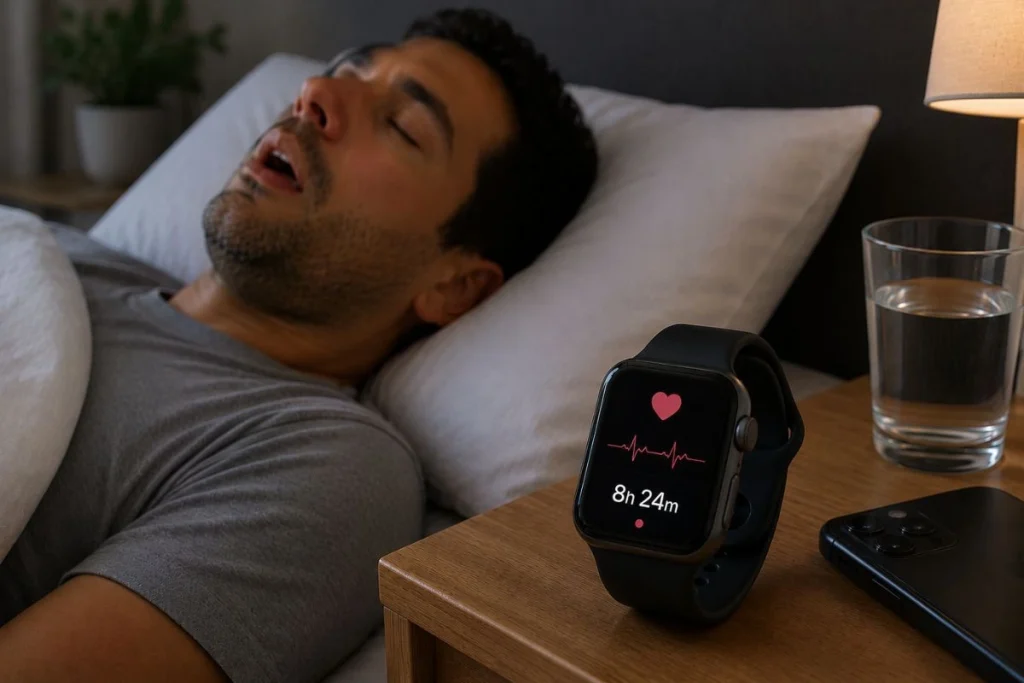
Apple Watch is useful because it can track sleep trends over time, such as how long you slept, how often you woke up, and whether your rest looks fragmented. For some users, that creates an early warning sign when daytime fatigue and poor sleep line up with unusual overnight patterns. It is helpful for awareness, but awareness is not the same as diagnosis.
The apple watch series sleep health monitoring tools can support a broader picture of sleep behavior, especially when paired with symptoms like loud snoring, gasping, or morning headaches. In general, these kinds of wearables are most valuable when they encourage people to seek evaluation sooner rather than later.. That can save time, reduce guesswork, and help a person move from suspicion to testing.
Apple Watch also belongs in the larger category of wearable device sleep apnea screening 2026, which is growing fast. These tools are getting better at identifying trends, but they still depend on indirect signals. They are not measuring airflow the same way a formal sleep study does, so they cannot fully replace it.
How Does Apple Watch Detect Possible Sleep Apnea?
Apple Watch does not diagnose sleep apnea directly, but it can look for patterns that may suggest a breathing-related sleep problem. Depending on the model and enabled health features, it may use overnight movement, sleep disruption patterns, heart-rate trends, and other sleep-related signals to help highlight unusual changes.
Some users also pay attention to overnight oxygen trends and repeated sleep disruption when trying to understand whether their sleep data matches symptoms like snoring, daytime fatigue, or waking up unrefreshed. That can make the watch a useful screening tool, but it is still looking at indirect clues rather than measuring airflow or confirming actual apnea events.
The most useful way to think about it is simple: Apple Watch may help you notice a pattern worth checking, while a sleep test is what helps confirm whether sleep apnea is truly present.
Apple Watch Limitations for Detecting Sleep Apnea
The biggest limitation is simple: Apple Watch does not directly measure every airway event the way a medical sleep study does. Sleep apnea can happen even if a person looks “fine” on a watch summary. That means a person could still have clinically important apnea while the watch misses it.
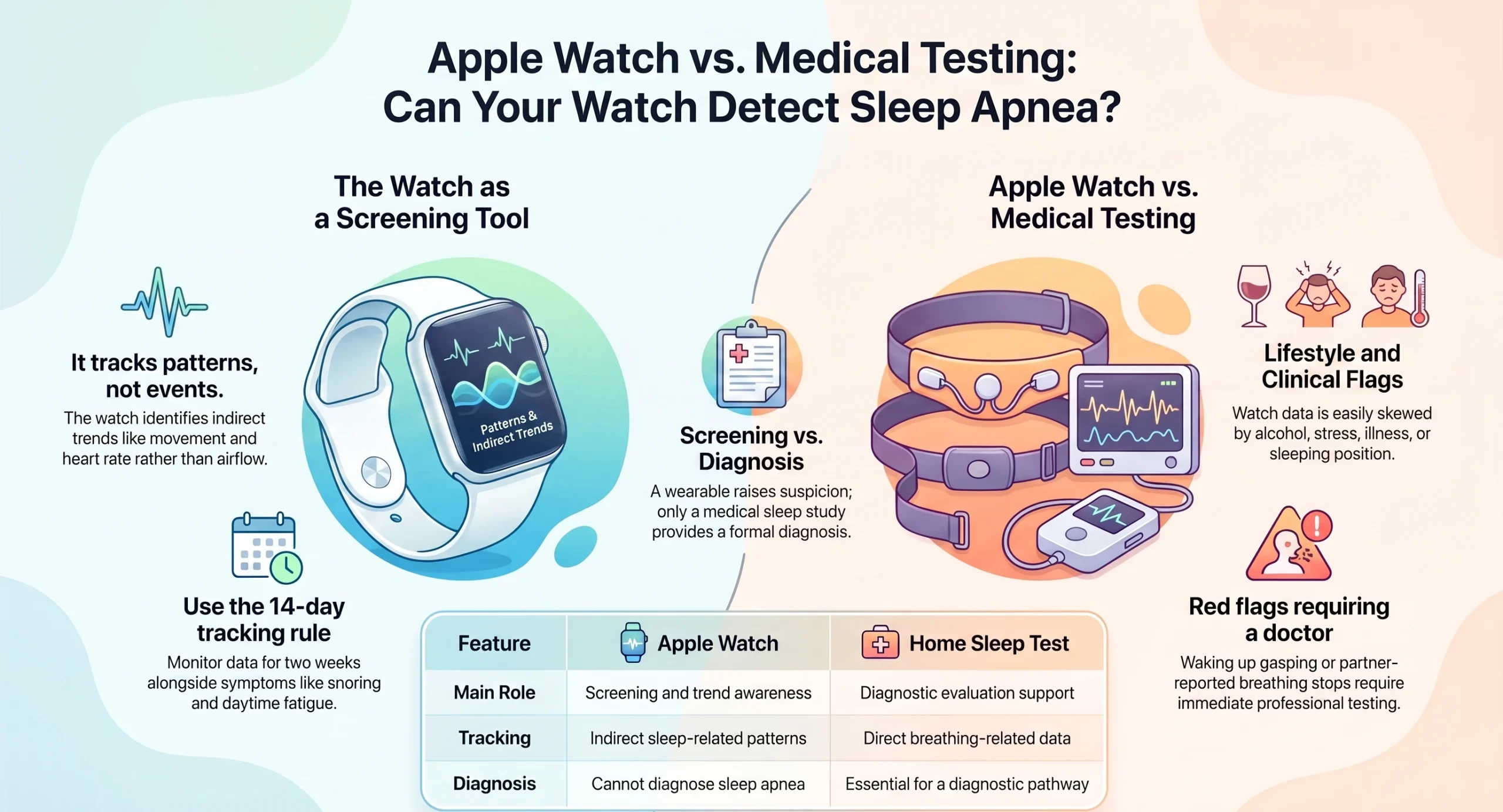
A second limitation is accuracy. Movement-based and heart-rate-based signals can suggest sleep disruption, but they can also be affected by stress, alcohol, illness, sleeping position, or even a bad night of rest. That is why the at-home sleep apnea test vs wearable accuracy comparison is important. Home tests and clinical sleep studies are built to evaluate breathing more directly, while wearables are mainly trend trackers.
So if someone asks can apple watch detect sleep apnea in the sense of giving a confirmed medical answer, the answer is no. If they ask whether it can help spot a possible problem worth checking, the answer is yes. Those are very different claims, and it helps to separate them clearly.
Apple Watch vs Home Sleep Test: Which Is More Accurate?
Feature | Apple Watch | Home Sleep Test |
Main role | Screening and trend awareness | Diagnostic evaluation support |
What it tracks | Indirect sleep-related patterns | Breathing-related sleep data more directly |
Can it diagnose sleep apnea? | No | Much closer to a real diagnostic pathway |
Convenience | Very easy to wear nightly | Slightly more involved, but still at home |
Best use | First clue that something may be wrong | Next step when symptoms or watch data raise concern |
How to Use Apple Watch Sleep Data the Right Way
Start by treating the watch as a signal, not a verdict. If your data shows poor sleep quality and you also notice snoring, choking, or daytime sleepiness, that combination deserves attention. The watch can help you notice a pattern, but your symptoms still matter most.
A simple approach works well:
- Track sleep for at least two weeks.
- Note snoring, gasping, morning headaches, and daytime fatigue.
- Compare how you feel on nights with alcohol, late meals, or back sleeping.
- If the pattern keeps showing up, get a sleep evaluation.
That approach is especially helpful for people who want a low-friction first step before doing a formal study. It is also useful when you are deciding whether you need a home sleep test, a clinic-based test, or just a better sleep routine.
When Should You Get Tested for Sleep Apnea?
You should not wait on a watch if you regularly wake up gasping, feel exhausted during the day, or have high blood pressure along with poor sleep. Those are red flags that need a proper medical look. A wearable can help you notice the issue, but it should not delay diagnosis.
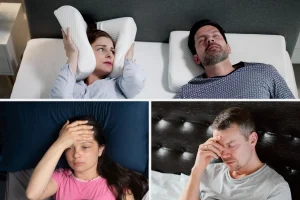
Also, if your partner says you stop breathing at night, that is a strong reason to get tested. The same goes for loud snoring paired with unrefreshing sleep. A watch may support the conversation, but it is the symptoms that should push you toward a test.
For anyone searching whether the can apple watch detect sleep apnea claim is enough to skip testing, the safest answer is no. It can be a useful starting point, but it should not be the final one. The better question is whether it helps you decide to take symptoms seriously, and in many cases, it does.
Common Mistakes to Avoid When Using Apple Watch for Sleep Apnea
One common mistake is assuming a normal watch report means everything is fine. Another is assuming a bad sleep score automatically means sleep apnea. Both conclusions are too simple. Wearables are better at pointing to a problem than proving exactly what the problem is.
Another mistake is comparing every wearable directly to a sleep lab test as if they are doing the same job. They are not. Wearables are convenient and helpful for patterns, while medical tests are designed for diagnosis. That is why people should use the watch as a screen, not as a substitute.
Wearables like Apple Watch are a useful starting point, but they’re only one piece of understanding sleep apnea. If your data or symptoms have you concerned, it helps to know the bigger picture — how the condition is diagnosed, what causes it, and which treatments actually work. Our sleep apnea complete guide covers all of that in one place.
Frequently Asked Questions About Apple Watch and Sleep Apnea
Can Apple Watch diagnose sleep apnea?
No, Apple Watch cannot diagnose sleep apnea on its own. It may help spot patterns that suggest poor sleep or possible breathing issues, but diagnosis needs a proper medical sleep test. That difference matters because many things can disrupt sleep without being apnea, including stress, alcohol, illness, and poor sleep habits.
What is the Apple Watch sleep apnea detection feature?
It is a health-related sleep monitoring function that can help identify patterns linked to possible breathing problems during sleep. It is best understood as a screening aid, not a diagnosis. If the watch data and your symptoms both point in the same direction, that is when a sleep evaluation becomes worthwhile.
How accurate is Apple Watch for sleep apnea?
It is not accurate enough to replace a medical test. Apple Watch can be useful for trend tracking, but it does not directly measure airflow the way sleep studies do. That means it can miss real apnea or raise concern when something else is causing the sleep problem.
Which Apple Watch models support sleep apnea-related monitoring?
Support depends on the specific model, watchOS version, and which sleep health features Apple has enabled for that device. In general, newer Apple Watch models tend to offer more advanced sleep and health tracking than older ones, so users should check their exact model and current Apple health feature availability.
Does Apple Watch measure oxygen for sleep apnea?
Some Apple Watch models include blood oxygen monitoring, which can add another useful data point when looking at overnight sleep trends. But oxygen data alone does not diagnose sleep apnea, and it should not be treated as proof or reassurance by itself.
Can Apple Watch detect snoring?
Apple Watch is not a direct snoring detector in the same way a dedicated audio-based app or sleep recording tool can be. It may still help you connect snoring with poor sleep patterns, repeated wake-ups, or next-day fatigue, especially when combined with what a bed partner notices.
Is the Apple Watch Series useful for sleep health monitoring?
Yes, the Apple Watch Series can be useful for sleep health monitoring because it tracks sleep duration, wake-ups, and general overnight patterns. That makes it helpful for people who want to understand their sleep better. It is most valuable when used alongside symptom tracking and not as a stand-alone answer.
How does wearable device sleep apnea screening 2026 compare with a home sleep test?
Wearable screening is easier and more convenient, but a home sleep test is much closer to a real diagnostic tool. Wearables look at indirect signals, while home tests measure breathing-related data more directly. If symptoms are strong or frequent, the home test is usually the better next step.
Should I trust Apple Watch if I snore a lot?
You should trust it as a clue, not a conclusion. If you snore a lot and the watch also shows poor sleep patterns, that combination is worth taking seriously. But snoring alone does not prove sleep apnea, and a watch cannot tell the full story by itself.
What symptoms mean I should get tested?
You should get tested if you wake up gasping, feel very sleepy during the day, have morning headaches, or have been told that you stop breathing in your sleep. Those signs suggest more than a simple sleep-quality issue. A wearable may help you notice the pattern, but symptoms should drive the decision.
Can a watch replace a sleep apnea machine or sleep study?
No, a watch cannot replace either one. It can help monitor sleep trends and encourage earlier action, but it does not treat sleep apnea and does not give a formal diagnosis. If treatment is needed, a doctor may recommend CPAP, another therapy, or a sleep-study-based plan.
Take the Next Step Toward Better Sleep
If your Apple Watch keeps showing poor sleep and your symptoms match sleep apnea, take the next step and get evaluated instead of guessing. CPAPRx Home Sleep Testing gives you a more reliable way to check what is really happening at home, without depending on wearable trends alone.
When symptoms keep repeating, clarity matters more than guesswork. A home sleep test through CPAPRx can help you move from suspicion to actual answers so you can decide on treatment with confidence.
Trusted Resources and Medical References
- American Academy of Sleep Medicine for sleep disorder guidance.
- National Heart, Lung, and Blood Institute for sleep apnea basics.
- Mayo Clinic for trusted information on sleep apnea symptoms, diagnosis, and treatment.
- NIH PubMed for wearable and sleep research.
- FDA for medical device safety information.
Medical Disclaimer: This article is for informational and educational purposes only and should not be considered medical advice, diagnosis, or treatment. Always consult a qualified healthcare provider if you have symptoms or concerns about sleep apnea.