Table of Contents
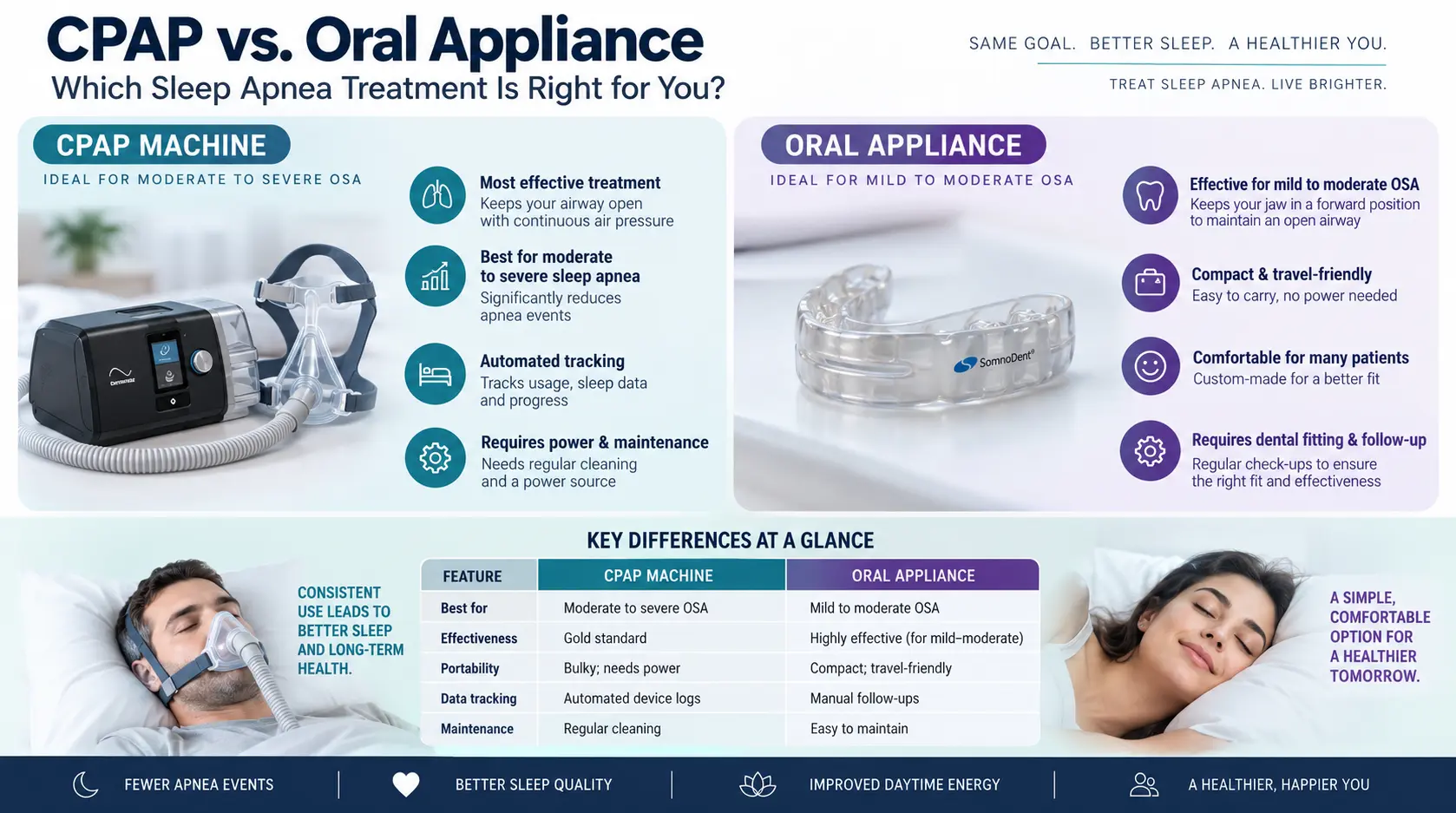
In the CPAP vs oral appliance choice, CPAP lowers apnea events more and suits moderate-to-severe sleep apnea, while an oral appliance fits mild-to-moderate cases and is easier to wear. The best option depends on severity, comfort, and consistent use.
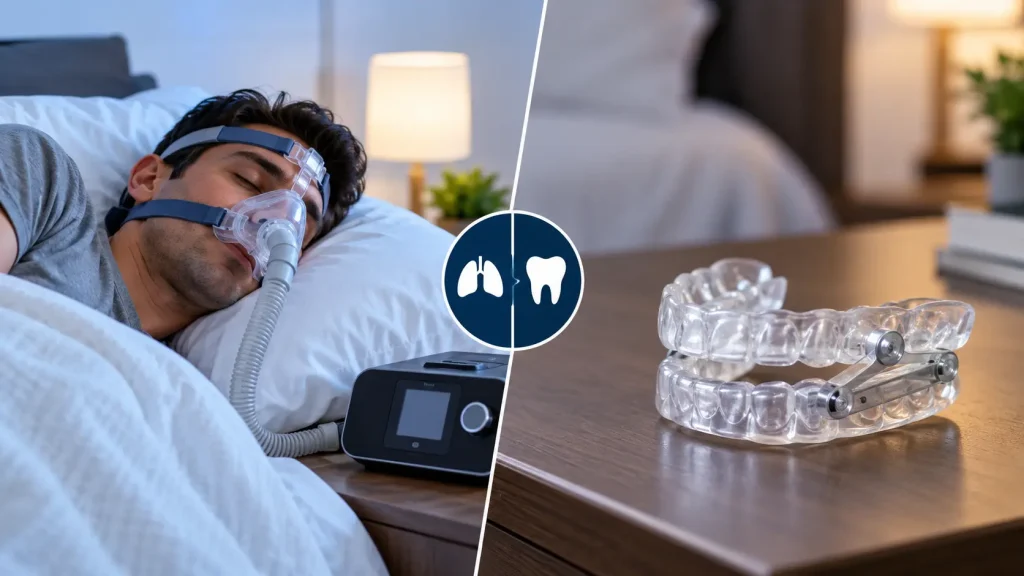
Sleep apnea treatment isn’t one-size-fits-all. Some people thrive with a bedside machine and mask, while others prefer a small dental device that gently moves the lower jaw forward. Understanding how each option works, what results to expect, and where each falls short helps you make a confident decision with your clinician — instead of guessing or giving up on treatment altogether.
New to CPAP upkeep, or comparing what daily care looks like? See our guide on how to clean a CPAP machine to know exactly what maintaining a machine involves before you choose.
Which One Actually Stops Your Sleep Apnea? (The Honest Answer)
Research consistently shows that CPAP lowers the apnea–hypopnea index (AHI) more than oral appliances across mild, moderate, and severe obstructive sleep apnea (OSA). In head-to-head studies, CPAP often brings AHI into the normal range for most users, while oral appliances typically reduce AHI by roughly 50–60% on average.
For severe OSA (AHI above 30), CPAP remains the preferred first-line therapy because it delivers the largest and most reliable drop in breathing disruptions and oxygen dips. Oral appliances can still help in severe cases when CPAP isn’t tolerated, but they usually don’t normalize AHI as often.
Here’s the nuance that matters most: the “best” therapy is the one you use every night. A powerful CPAP that sits in a drawer helps no one, while an oral appliance worn consistently can close much of the real-world gap for the right patient.
Which Is Easier to Live With, Night After Night?
Comfort and daily habits matter just as much as raw AHI numbers. CPAP requires a mask, tubing, and a bedside machine, which some people find bulky, noisy, or claustrophobic. Common complaints include dry mouth or nose, skin irritation from the mask, nasal congestion, and feeling confined.
Oral appliances are small, quiet, and travel-friendly. They look like sports mouthguards and fit inside the mouth, so there’s no mask or hose. Many users find them easier to tolerate night after night, which can narrow the gap in real-world outcomes even when CPAP is technically more powerful.
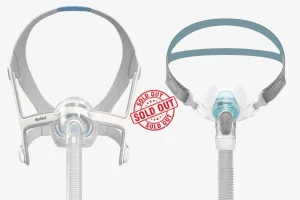
Struggling with a CPAP mask before you switch? Mask intolerance is often a fit problem, not a CPAP problem. Trying a different style — a nasal pillow mask instead of a full-face one, for example — plus using ramp and pressure-relief settings solves it for many people before they abandon CPAP entirely.
The Downsides Nobody Warns You About (Both Options)
CPAP side effects usually involve the mask and airflow: pressure marks, leaks, dryness, and occasional bloating from swallowed air. Most improve with better mask fit, humidification, and pressure adjustments, though some people never feel fully comfortable.
Oral appliances can cause jaw soreness, tooth or gum tenderness, dry mouth or extra saliva, and, over time, small changes in bite or tooth position. Regular follow-ups with a dental sleep specialist help monitor these changes and adjust the device as needed.
Which One Is Right for YOUR Sleep Apnea?
If You Have Mild to Moderate Sleep Apnea
For mild to moderate OSA (AHI roughly 5–30), both CPAP and oral appliances are considered reasonable first-line options in many guidelines. While CPAP still lowers AHI more, oral appliances often produce similar improvements in daytime sleepiness and quality of life because people wear them more consistently. If you value simplicity, travel often, or strongly dislike the idea of a mask, an oral appliance may be an excellent fit — provided you’re monitored and retested to confirm it works for you.
If Your Sleep Apnea Is Moderate to Severe
For moderate to severe OSA (AHI above 15–30), CPAP is usually the preferred starting point because it achieves the greatest and most reliable reduction in breathing events and oxygen drops. This matters for long-term heart and brain health, not just how you feel in the morning. An oral appliance can be considered when CPAP isn’t tolerated despite careful adjustments — and in these cases, a follow-up sleep study with the device is essential to confirm it controls your apnea.
Special Cases: Back-Sleepers & Complex Situations
Some people have mostly positional OSA, where events are far worse when sleeping on the back. Here, positional therapy or weight management may be added to either option. If you have significant nasal blockage, severe jaw or dental issues, or certain medical conditions, one option may be clearly better or unsuitable — a sleep physician and, when relevant, a dental sleep specialist should review your anatomy, sleep study, and health history first.
CPAP vs Oral Appliance: The Full Comparison, Side by Side
Feature | CPAP | Oral Appliance (mandibular advancement device) |
How it works | Delivers gentle air pressure through a mask to keep the airway open | Moves the lower jaw and tongue forward to widen the airway |
Best supported for | Moderate to severe OSA; highest AHI reduction | Mild to moderate OSA; CPAP-intolerant patients |
Typical AHI reduction | Often normalizes AHI in most users | Reduces AHI ~50–60% on average; less in severe OSA |
Daily routine | Mask, tubing, machine, power; cleaning required | Insert device, clean mouthpiece; no machine or power |
Travel | Bulkier; needs power and mask setup | Very portable; no power needed |
Common side effects | Dryness, congestion, mask marks, claustrophobia, leaks | Jaw/tooth soreness, dry mouth, bite changes over time |
Monitoring | Device data (usage, leaks, AHI estimates) | Dental follow-ups; repeat sleep study to confirm |
Cost pattern | Machine + ongoing supplies (mask, tubing, filters) | Custom device + periodic dental adjustments |
This table shows general patterns; your experience may differ based on anatomy, severity, and how consistently you use the therapy.
What Will It Actually Cost You? (And Will Insurance Pay?)
Cost is often the deciding factor, and the two work very differently. A CPAP setup is usually a machine plus ongoing supplies — the machine is the upfront cost, then masks, cushions, filters, and tubing are replaced on a schedule. A custom oral appliance is typically a higher one-time cost (it’s custom-made and fitted by a dental sleep specialist), followed by periodic adjustment visits.
Insurance changes the math for both. Many medical plans cover CPAP as durable medical equipment, often requiring documented nightly usage to keep coverage active. Custom oral appliances are frequently covered too — sometimes under medical benefits rather than dental — but coverage, prior-authorization rules, and out-of-pocket costs vary widely by plan. If a dentist recommended an oral appliance because “insurance covers it,” confirm exactly what’s covered and whether a follow-up sleep test is required.
One important warning: a custom, titrated oral appliance from a qualified provider is not the same as an over-the-counter mouthguard. OTC “boil-and-bite” devices are cheaper but aren’t validated to treat sleep apnea and can even worsen your bite. For sleep apnea, only a professionally fitted device should be used.
Still Torn? Here’s How to Decide (With Confidence)
Start with your sleep study results and symptoms. If your AHI is high, you have significant oxygen drops, or you carry other health risks, CPAP is often the safest first step. If your OSA is mild to moderate and you strongly prefer a smaller, quieter option, an oral appliance is a reasonable path — provided you commit to follow-up testing.
Talk openly about comfort. If you’ve tried CPAP and struggled with mask fit, dryness, or anxiety, ask about different mask styles, humidification, pressure-relief features, and desensitization before ruling it out. If you’re considering an oral appliance, make sure it’s custom-made and titrated by a qualified dental sleep provider — never a generic mouthguard.
Finally, plan for reassessment. Whatever you choose, a follow-up sleep study or detailed therapy review confirms your treatment is actually controlling your apnea, not just feeling more comfortable. Not sure whether gadgets like automatic CPAP cleaners are worth adding to your routine? Our honest breakdown of whether CPAP cleaners are worth the money can help you skip unnecessary costs.
FAQ's
Is CPAP more effective than an oral appliance for sleep apnea?
Yes, CPAP is generally more effective for reducing apnea events and improving oxygen levels, especially in moderate to severe OSA. Studies show CPAP lowers AHI more than mandibular advancement devices, though oral appliances still provide meaningful symptom relief. For many people, the real-world outcome depends heavily on how consistently they use their chosen therapy.
How much does an oral appliance cost compared to CPAP?
A custom oral appliance is usually a higher one-time cost fitted by a dental sleep specialist, while CPAP is a machine cost plus ongoing supplies over time. Actual prices vary by provider and region. Confirm the total, including follow-up and adjustment visits, before deciding.
Does insurance cover an oral appliance or dental device for sleep apnea?
Many plans cover both CPAP and custom oral appliances, though an oral appliance is sometimes billed under medical rather than dental benefits. Coverage, prior authorization, and out-of-pocket costs vary widely, so verify your specific plan and whether a follow-up sleep test is required.
Is a mouthguard from the dentist as good as a custom oral appliance?
A professionally custom-made, titrated oral appliance is designed to treat sleep apnea; an over-the-counter boil-and-bite mouthguard is not. OTC devices aren’t validated for apnea and can worsen your bite. Only use a device fitted and monitored by a qualified provider.
Will an oral appliance change my teeth or bite over time?
It can. Long-term oral appliance use may cause small shifts in bite or tooth position, which is why regular dental follow-ups matter. A dental sleep specialist monitors these changes and adjusts the device to balance effectiveness with dental health.
Can an oral appliance replace CPAP for severe sleep apnea?
Usually not fully, because it reduces AHI less than CPAP. CPAP remains first-line when AHI is high or oxygen levels drop significantly. An oral appliance may be considered for severe OSA only when CPAP isn’t tolerated, and a follow-up sleep study is essential to confirm adequate control.
Can I switch back to CPAP if the oral appliance doesn’t work?
Yes. Many people move between therapies as their needs change. If an oral appliance doesn’t adequately control your apnea on a follow-up sleep study, returning to CPAP — often with a better-fitting mask — is a common and reasonable next step.
Can I use both CPAP and an oral appliance together?
In some cases, yes — combination therapy can help when one device alone doesn’t fully control apnea, or to allow lower CPAP pressures. This should only be done under guidance from a sleep physician and, when relevant, a dental sleep specialist, with monitoring and possibly repeat testing.
Hate Your CPAP Mask? Don’t Quit Until You Try This
The most common reason people switch away from CPAP is an uncomfortable mask — and that’s usually solvable. A nasal pillow mask suits many side sleepers and people who feel claustrophobic; a full-face mask helps mouth breathers; and the right cushion size stops most leaks and pressure marks. If mask discomfort is what’s pushing you toward an oral appliance, it’s worth trying a better-fitting mask first.
Explore CPAP masks — nasal, nasal-pillow, and full-face styles for different sleep positions and breathing habits — to find a fit that makes CPAP comfortable enough to stick with. If you and your clinician still decide an oral appliance is the better route, that’s a valid, evidence-based choice too.
Resources & Further Reading
Medical Disclaimer: This article is for general education only and is not medical advice. Sleep apnea treatment should be chosen and monitored by a qualified sleep physician and, where relevant, a dental sleep specialist. Individual results vary. In an emergency, call 911.