
Table of Contents
Quick Answer: Can You Check for a Deviated Septum at Home?
A deviated septum self test can help you spot one-sided nasal blockage, noisy breathing, mouth breathing, and other common signs, but it cannot confirm the diagnosis. A doctor is still needed for a definite answer, especially if symptoms are frequent or getting worse.
A home self-test can identify possible signs of a deviated septum, but only an ENT examination can confirm the diagnosis and rule out other causes of nasal obstruction.
What Is a Deviated Septum?
Your septum is the wall of bone and cartilage that separates your two nostrils. When it is off-center, one side of the nose can feel narrower, which may reduce airflow and make breathing feel uneven. Many people have a mild deviation without symptoms, while others notice congestion, nosebleeds, or disturbed sleep.
That is why a deviated septum self test is best used as a quick screening tool, not a diagnosis. A simple home check can give you a clue about whether one nostril consistently feels more blocked than the other, but only an exam can confirm the cause.
5 Signs You May Have a Deviated Septum
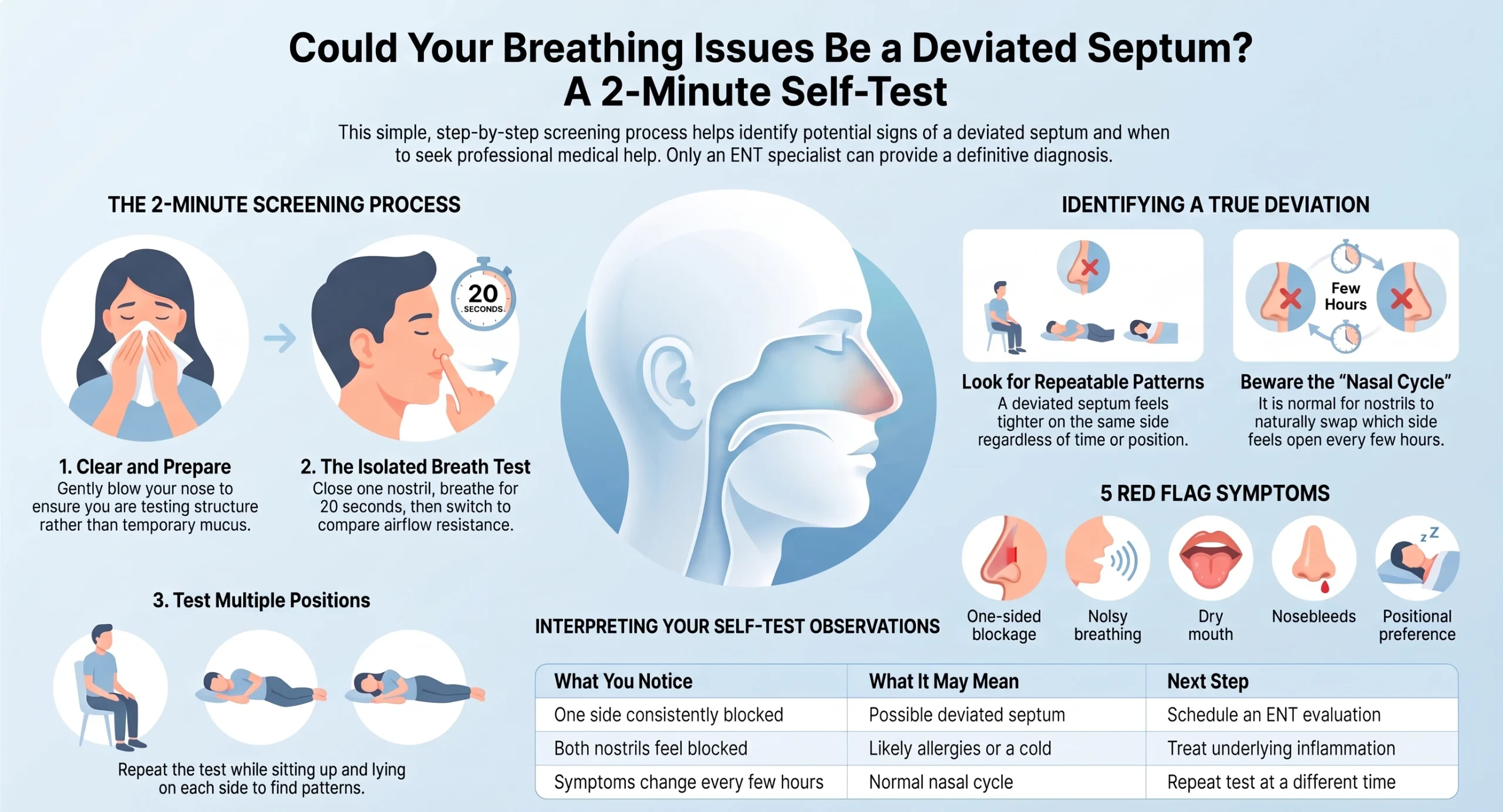
Here are five simple signs that can help you check for a deviated septum at home. These quick self-checks take less than two minutes and work best when your nose is clear of a cold, sinus infection, or allergy flare-up.
One Nostril Feels Harder to Breathe Through
Close one nostril and breathe gently through the other, then switch sides. If the same side feels consistently tighter, that can point to uneven airflow.
You Breathe Better on One Side When Lying Down
Try lying on your left side, then your right side, and notice whether one nostril opens up more than the other. People with septal deviation often notice a repeat pattern rather than random blockage.
You Snore or Have Noisy Breathing
Noisy breathing during sleep can happen when nasal airflow is narrowed. It is not specific to one cause, but it is one of the common signs of deviated nasal septum breathing
You Wake Up With a Dry Mouth
If you regularly sleep with your mouth open because your nose feels blocked, that can dry out your mouth and throat. This often shows up when nasal breathing is hard at night.
If nasal blockage is affecting your sleep, learn how a deviated septum and sleep apnea may be connected and when a sleep evaluation is recommended.
Frequent Nosebleeds or Nasal Dryness
Dry air passing through a narrowed passage can irritate the inside of the nose. Frequent nosebleeds do not prove a septum issue, but they are a useful clue when paired with one-sided blockage.
Deviated Septum Self-Test Results: What They May Mean
What You Notice | What It May Mean | Next Step |
One nostril is consistently harder to breathe through | Possible deviated septum or nasal obstruction | Monitor symptoms and schedule an ENT evaluation if it continues |
Both nostrils feel blocked | More likely allergies, a cold, or sinus congestion | Treat the underlying condition and repeat the self-test when your nose is clear |
Loud snoring with daytime tiredness | May indicate sleep apnea in addition to nasal blockage | Consider an at-home sleep test and consult a healthcare provider |
Frequent nosebleeds and nasal dryness | Possible irritation from restricted airflow | See an ENT specialist if symptoms are persistent |
Symptoms change every few hours | May be the normal nasal cycle | Repeat the self-test at different times before drawing conclusions |
How to Perform a Deviated Septum Self-Test at Home
Start by gently blowing your nose to clear out mucus—you want to test the structure, not a temporary clog. Then close one nostril and breathe in and out through the open side for about 20 seconds, noticing how easy or strained it feels. Switch sides and compare. Do this sitting up, and again while lying on each side—position changes often make a deviated septum more obvious.
Here’s the catch: your nose naturally swaps which side feels more open every few hours. That’s the “nasal cycle,” and it’s completely normal. A true deviated septum, however, shows a repeatable pattern—the same side feels tighter no matter the time or position. So test yourself at different times—morning, afternoon, and before bed—and jot down which side feels more blocked each time. Also note if you snore, wake up with a dry mouth, or get nosebleeds. This little diary is gold for your ENT appointment—it helps them connect your symptoms to the structure faster than relying on memory alone.
Common Mistakes When Checking for a Deviated Septum
The biggest mistake is testing during a cold, sinus infection, or allergy flare, because swelling can mimic the same blocked feeling. Another mistake is assuming every blocked nostril means a deviated septum; congestion, enlarged turbinates, polyps, and allergies can also reduce airflow.
People also overread a one-time result. A real structural issue usually creates a repeatable pattern, not a random bad-breathing day. If your symptoms are mild and occasional, the issue may be irritation rather than a structural problem.
A deviated septum is just one possible piece of the puzzle when nasal breathing and sleep both feel off. If you’re also noticing snoring, daytime tiredness, or breathing pauses, it’s worth understanding the bigger picture before assuming the septum is the whole story. Our sleep apnea complete guide covers the symptoms, causes, and diagnosis path in full.
When Should You See an ENT Specialist?
You should see a clinician if one nostril stays blocked, you have frequent nosebleeds, or your sleep is being affected. Mayo Clinic notes that a blocked nostril that does not clear up and repeated nosebleeds are both reasons to get evaluated.
Medical evaluation matters because a deviated septum is diagnosed by examination, and surgery is the only way to correct the structure when symptoms are significant. In other words, home checks can raise suspicion, but they cannot replace a proper nasal exam.
Frequently Asked Questions About Deviated Septum Self-Test
Q: How do I know if I have a deviated septum at home?
A: A home self-test can help you recognize a pattern of one-sided nasal blockage, but it cannot confirm a deviated septum. If symptoms continue for several weeks or interfere with breathing or sleep, an ENT examination is the most reliable way to determine the cause.
Q: Can a mild deviated septum cause symptoms?
A: Many people with a mild deviated septum have no symptoms at all. Others may notice occasional nasal congestion, mild breathing difficulty, or snoring. Symptoms become more noticeable when the deviation significantly restricts airflow or is combined with allergies, a cold, or nasal inflammation.
Q: Can a deviated septum cause snoring?
A: Yes. A deviated septum can contribute to snoring by reducing nasal airflow and encouraging mouth breathing during sleep. However, persistent snoring may also be a sign of obstructive sleep apnea. If snoring is combined with daytime fatigue or witnessed breathing pauses, seek a medical evaluation.
Q: How can I fix a deviated septum without surgery?
A: A deviated septum cannot be permanently corrected without surgery because it is a structural problem. However, symptoms may improve with saline nasal sprays, allergy treatment, nasal steroid sprays, humidifiers, or nasal strips if inflammation is making breathing worse. If symptoms remain severe, an ENT specialist may recommend septoplasty.
Q: Is a home visual check useful?
A: A quick mirror check may reveal one nostril that appears narrower or a septum that looks off-center. However, the appearance of your nose does not always reflect the position of the septum inside. A visual check can provide clues but cannot confirm a diagnosis.
Q: Can allergies make the self-test misleading?
A: Yes. Allergies can cause swelling inside the nose, making one or both nostrils feel blocked. For the most accurate self-test, check your breathing when you are free from a cold, sinus infection, or allergy flare-up.
Q: What actually happens during an ENT examination?
A: An ENT specialist will review your symptoms and examine the inside of your nose using a light or a small nasal endoscope. This helps identify whether your breathing problems are caused by a deviated septum, nasal polyps, inflammation, or another condition.
Q: Can a CT scan diagnose a deviated septum?
A: A CT scan is not usually needed to diagnose a deviated septum. In most cases, an ENT specialist can identify the condition during a physical examination or with a nasal endoscope. Imaging is typically reserved for complex cases or when other sinus conditions are suspected.
Q: Can a deviated septum go away on its own?
A: No. A true deviated septum does not straighten itself because it is a structural condition. While symptoms may improve when allergies or congestion are treated, the deviation remains unless corrected with surgery.
Q: What is the difference between congestion and a deviated septum?
A: Congestion is usually temporary and caused by swelling, mucus, or irritation, while a deviated septum is a permanent structural change inside the nose. Congestion often improves with medication, whereas a deviated septum typically causes a consistent pattern of one-sided nasal blockage.
Not Sure Whether Your Symptoms Are Related to Sleep Apnea?
Still unsure whether your symptoms are caused by a deviated septum or sleep apnea? An at-home sleep test can provide valuable insights into your breathing while you sleep and help determine whether further evaluation is needed.
Trusted Medical Resources
- Mayo Clinic – Deviated Septum: Symptoms & Causes
- Mayo Clinic – Deviated Septum: Diagnosis & Treatment
- Cleveland Clinic – Deviated Septum Overview
- NHS – Septoplasty Information
Medical Disclaimer:This article is for informational and educational purposes only and should not be considered medical advice, diagnosis, or treatment. A deviated septum self-test cannot replace an examination by a qualified healthcare provider or ENT specialist. If you have persistent nasal blockage, frequent nosebleeds, loud snoring, or concerns about your breathing, seek professional medical evaluation for an accurate diagnosis and appropriate treatment.