Table of Contents
Quick answer
Sleep apnea lifestyle changes may help reduce symptoms through five key habits: losing excess weight, sleeping on your side, avoiding alcohol before bed, staying physically active, and keeping a consistent sleep schedule. These changes work best alongside medical treatment, not as a replacement for it.
What Are the Best Lifestyle Changes for Sleep Apnea?
Sleep apnea is a condition where breathing repeatedly slows or stops during sleep because the airway becomes blocked or partially narrowed. For many people, small daily choices — what you eat, how you sleep, what you do before bed — can make symptoms noticeably worse or better, especially when sleep apnea is mild.
The right habits can support treatment and, in some cases, reduce the number of breathing pauses at night — but they don’t replace medical care for moderate or severe sleep apnea. This guide focuses on the specific changes you can start tonight, and how they work alongside CPAP or other treatment rather than instead of it.
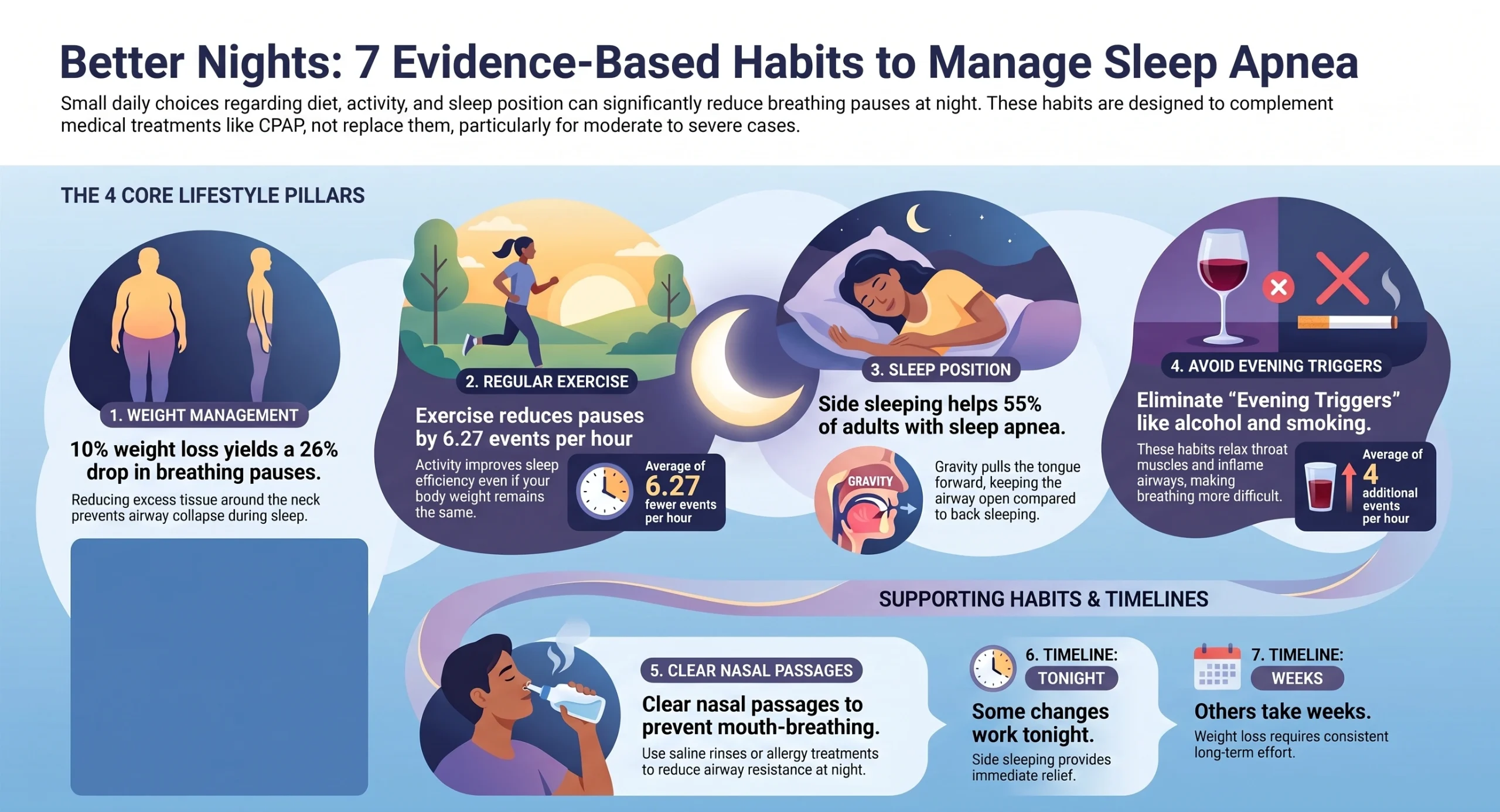
7 Habits at a Glance — 4 Core Steps + 3 Supporting Habits
Habit | Type | What the Evidence Shows |
Losing excess weight | Core step | A 10% weight loss is linked to a 26% drop in breathing pauses per hour (Peppard et al., 2000) |
Sleeping on your side | Core step | Affects about 55% of adults with OSA — positional apnea responds directly to this change (Verhelst et al., 2019) |
Regular exercise | Core step | Reduces breathing pauses by ~6 events/hour even without major weight loss (Iftikhar et al., 2014) |
Avoiding alcohol before bed | Core step | Increases breathing pauses by ~4 events/hour and lowers blood oxygen (Simou et al., 2018) |
Quitting smoking | Supporting habit | Reduces airway inflammation that narrows breathing passages overnight |
Managing nasal congestion | Supporting habit | Clearer nasal passages reduce mouth-breathing and airway resistance |
Consistent sleep schedule | Supporting habit | Stabilizes sleep architecture, reducing the depth of sleep stages linked to more frequent pauses |
While no single change cures sleep apnea, combining these habits with appropriate medical treatment measurably improves sleep quality, daytime energy, and long-term health outcomes.
These habits work best when you understand what you’re actually managing. Sleep apnea is far more common — and far more often undiagnosed — than most people realize. Our Sleep Apnea Facts guide breaks down exactly how many people are affected, why it goes unnoticed for years, and what the condition does to your body over time.
1. Lose Excess Weight — The Change With the Strongest Evidence
Weight loss has the largest, most consistently measured effect on sleep apnea severity of any lifestyle change. A landmark study following 690 adults over four years found that a 10% weight loss predicted a 26% decrease in the apnea-hypopnea index (AHI) — while a 10% weight gain predicted a 32% increase. The same study found a 10% weight gain made moderate-to-severe sleep apnea six times more likely to develop. (Peppard et al., 2000)
This matters because extra tissue around the neck and upper airway makes airway collapse more likely at night. A steady, realistic plan is better than extreme dieting, since crash diets are hard to maintain and often lead to regaining the weight — along with the symptoms.
A balanced eating plan, portion control, and gradual weight loss are more sustainable than trying to change everything at once. Even a modest 5-10% reduction in body weight is enough to produce a measurable difference, based on the research above.
Can Diet Changes Help Sleep Apnea?
A healthy diet supports sleep apnea management primarily by helping you reach and maintain a healthy weight. Focus on balanced meals with vegetables, lean proteins, whole grains, and fewer processed foods. Heavy meals and alcohol close to bedtime worsen nighttime breathing directly — both relax throat muscles and increase airway collapse risk (see Section 4 below).
2. Move More During the Day — No Gym Required
Regular exercise is another core part of sleep apnea care — and its benefits go beyond weight management. A 2014 meta-analysis of five clinical studies found that supervised exercise training reduced the AHI by an average of 6.27 events per hour, even with minimal changes in body weight. The same research showed measurable improvements in daytime sleepiness and sleep efficiency. (Iftikhar et al., 2014)
You do not need intense workouts to get these benefits. The World Health Organization recommends at least 150 minutes of moderate-intensity activity per week — roughly 30 minutes, five days a week — and that general target applies here too. (WHO Physical Activity Guidelines) A brisk walk, cycling, light strength training, or any activity you can do consistently is a good starting point, especially if you have been inactive for a while.
Exercise works best as part of a wider routine rather than a stand-alone fix. Combined with better eating, consistent sleep timing, and fewer evening triggers like alcohol, physical activity supports the other changes in this guide instead of replacing them.
3. Sleep on Your Side — The Easiest Change to Try Tonight
Side sleeping can help because lying on your back makes gravity pull the tongue and soft tissues backward, narrowing the airway. NHS guidance specifically recommends side sleeping for some people with sleep apnea. Research published in the journal Sleep and Breathing found that positional sleep apnea affects about 55% of adults with obstructive sleep apnea — meaning their breathing pauses happen mainly, or only, when sleeping on their back. (Verhelst et al., 2019)
This is one of the easiest changes to try tonight. A body pillow, wedge pillow, or even a tennis ball sewn into the back of a shirt can stop you from rolling onto your back — a low-tech trick that’s been used in sleep clinics for years.
This habit is worth prioritizing first because it requires no equipment purchase, no appointment, and no lifestyle overhaul — unlike weight loss or exercise, which take weeks to show results. It works best alongside a proper diagnosis, since only a sleep test can confirm whether your apnea is truly positional.
4. Avoid Evening Triggers — What Not to Do Before Bed
Alcohol measurably worsens sleep apnea. A systematic review and meta-analysis of 13 studies found that alcohol consumption increased the AHI by nearly 4 events per hour and lowered blood oxygen levels compared to nights without alcohol. (Simou et al., 2018) Alcohol and sedatives relax the throat muscles beyond their normal resting tone, directly increasing airway collapse. Smoking adds a second mechanism — inflaming and irritating the airway lining, which narrows the passage further.
Late-night alcohol, heavy meals, and unprescribed sleep medications compound each other — each one independently increases the likelihood of breathing pauses, and combined, the effect is worse than any one alone.
A better evening routine is simple: stop alcohol at least 3-4 hours before bedtime, avoid smoking, and keep your sleep schedule regular. Based on the research above, this is one of the fastest lifestyle changes to show a measurable effect — often within the first few nights.
3 More Supporting Habits Worth Building In
Quit Smoking
Smoking inflames and irritates the upper airway lining, physically narrowing the passage air must travel through during sleep — independent of any effect on weight. Quitting reduces this inflammation over time and supports easier, quieter breathing at night.
Manage Nasal Congestion
A blocked nose forces mouth breathing, which reduces the natural airway support your tongue and soft palate normally provide. Treating allergies, using a saline rinse, or addressing chronic congestion with a doctor’s guidance can meaningfully improve nighttime airflow, especially for people who breathe primarily through their mouth at night.
Keep a Regular Sleep Schedule
Going to bed and waking at consistent times stabilizes your sleep architecture — the natural cycling between light, deep, and REM sleep. Irregular schedules push more sleep into lighter stages, where airway muscles relax more and breathing pauses are more frequent.
A Simple Sleep Apnea Lifestyle Plan
Start with small, realistic changes instead of trying to change everything at once. Begin by sleeping on your side and avoiding alcohol before bedtime — both show measurable results within days. Add regular movement and a consistent sleep schedule once those two habits feel automatic.
The goal is consistency, not perfection. Lifestyle changes for obstructive sleep apnea work best when they become part of your daily routine and support long-term sleep health, rather than a short-term fix you abandon after a few weeks.
Common Mistakes
- Assuming lifestyle changes alone will cure every case. This can happen in mild sleep apnea for some people, but many patients still need CPAP or another treatment plan alongside these habits.
- Making changes too aggressively. Extreme dieting, overtraining, or trying to fix everything overnight leads to burnout, making the plan harder to sustain than a slower, steady approach.
- Underestimating nighttime habits. Based on the research in Section 4, even one evening of alcohol can measurably undo the progress made through days of good daytime habits.
Getting the daily habits right is only half the picture. Sleep apnea itself — its causes, how it’s diagnosed, and which treatment actually fits your severity — is worth understanding fully before deciding which changes matter most for you. Our sleep apnea complete guide walks through all of that in one place.
FAQ's
What are the best sleep apnea lifestyle changes to start with?
The four changes with the strongest evidence are losing excess weight, exercising regularly, sleeping on your side, and avoiding alcohol at night. Each has been studied directly for its effect on breathing pauses per hour, not just general health.
How can I improve sleep apnea with lifestyle habits?
Build a routine that lowers airway strain from multiple directions at once: eat to reach a healthy weight, move daily, sleep on your side, and keep alcohol and smoking away from bedtime. These changes compound — doing three consistently outperforms doing one perfectly.
Does weight loss really help sleep apnea?
Yes — this has one of the strongest evidence bases of any lifestyle change. A 10% weight loss is associated with a 26% reduction in breathing pauses per hour, based on a four-year longitudinal study. (Peppard et al., 2000)
What habits make sleep apnea worse at night?
Alcohol, smoking, sleeping pills, and sleeping on your back are the four most well-documented habits that worsen sleep apnea. Alcohol alone has been shown to increase breathing pauses by nearly 4 events per hour in controlled studies.
Is exercise helpful for sleep apnea?
Yes — a clinical meta-analysis found exercise training reduces breathing pauses by an average of 6.27 events per hour, even without significant weight loss. A regular walking or movement routine, following the WHO’s 150-minutes-per-week guideline, is a strong first step.
Can side sleeping reduce sleep apnea symptoms?
Yes, for the roughly 55% of adults whose sleep apnea is positional — meaning it’s worse specifically when lying on the back. For this group, side sleeping directly reduces the number of breathing pauses. A sleep test can confirm whether your apnea falls into this category.
Do lifestyle changes replace CPAP for obstructive sleep apnea?
No. Lifestyle changes support symptom management, but people with moderate or severe sleep apnea typically still need CPAP or another doctor-recommended treatment. These habits work best as a complement to treatment, not a substitute for it.
How long do lifestyle changes take to work?
Side sleeping and avoiding alcohol can show effects within days, since both act on the airway directly the same night. Weight loss and exercise take longer — typically weeks to a few months — since they work through gradual physiological change rather than an immediate mechanical effect.
What foods should I avoid with sleep apnea?
Avoid heavy meals, fried foods, sugary snacks, alcohol, and sedatives before bed. Each of these either promotes weight gain over time or directly relaxes the airway in the hours after eating or drinking, increasing the odds of breathing pauses that night.
When are lifestyle changes not enough for sleep apnea?
If moderate or severe sleep apnea is confirmed by a sleep test, lifestyle changes alone are usually not sufficient. At that point, CPAP, oral appliances, or other doctor-recommended therapies are typically needed alongside — not instead of — the habits in this guide.
Ready to Put These Habits Into Action?
If you haven’t been tested yet, an at-home sleep test is the fastest way to find out whether your sleep apnea is mild, moderate, or severe — and whether it’s positional, which changes how much side-sleeping alone can actually help. Results come back in 3-5 days, reviewed by a board-certified sleep physician, with no lab visit required.
If you’re already diagnosed, matching these lifestyle habits with the right CPAP equipment makes it far easier to stay consistent with your care plan long-term. A mask that leaks or a machine that’s uncomfortable undoes the benefit of every other habit on this list — browse our full CPAP range to find what fits your therapy.
Trusted Resources & Further Reading
- NHS – Sleep Apnea
- NIH/NHLBI – Sleep Apnea Treatment
- NIH/NHLBI – Sleep Apnea Causes and Risk Factors
- PubMed Central (PMC) – Lifestyle Modification for Obstructive Sleep Apnea
- PubMed – Positional Obstructive Sleep Apnea Prevalence (Verhelst et al., 2019)
- PubMed – Weight Change and Sleep-Disordered Breathing (Peppard et al., 2000)
- PubMed – Exercise Training Meta-Analysis for Sleep Apnea (Iftikhar et al., 2014)
- PubMed – Alcohol and Sleep Apnea Meta-Analysis (Simou et al., 2018)
- WHO – Physical Activity Guidelines
Medical Disclaimer
This content is for informational purposes only and is not medical advice. Lifestyle changes may help manage sleep apnea but do not replace professional diagnosis or treatment. Always consult a qualified healthcare provider before making changes to your treatment plan.