Table of Contents
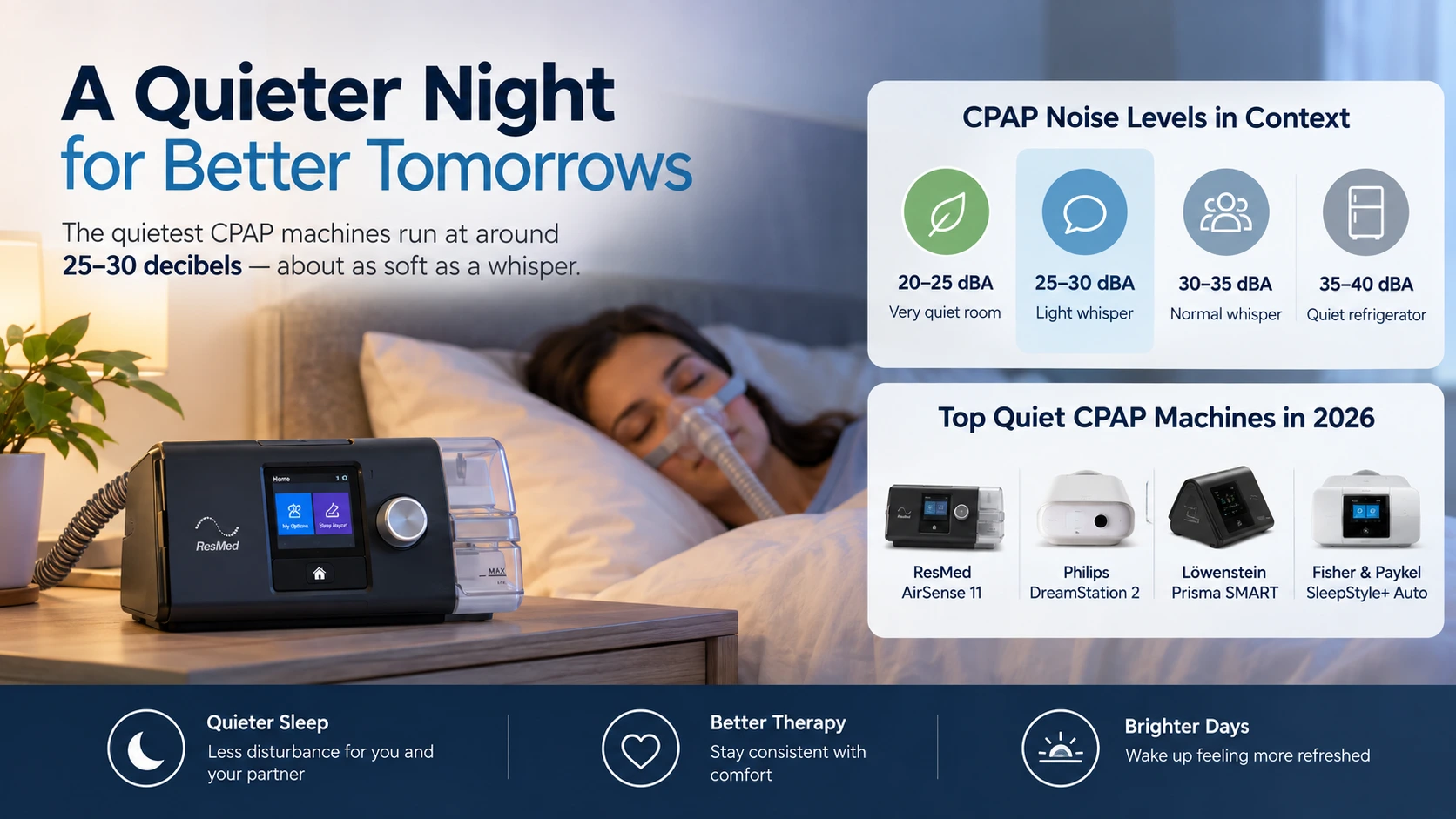
The quietest CPAP machines run at around 25–30 decibels — about as soft as a whisper. If you’re a light sleeper, or your partner wakes at the faintest hum, models like the ResMed AirSense 11, Philips DreamStation 2, and Löwenstein Prisma SMART are consistently among the quietest options in 2026.
Here’s the thing most buyers get wrong: they shop by price or features first, then discover the noise is what actually ruins their sleep. If sound is your dealbreaker, flip that order — make the decibel rating your first filter, not an afterthought. This guide explains what “quiet” really means in numbers, which machines genuinely earn the title, and how to quiet down the machine you already own.
For the bigger picture on choosing any machine — types, comfort features, and cost — start with our complete CPAP machine buying guide, then use this page to zero in on noise.
What actually makes a CPAP machine quiet?
Three things create the sound you hear at night: the motor, the airflow moving through the system, and the humidifier. A truly quiet machine manages all three — not just one.
Modern motors use better bearings and insulated housings to kill the high-pitched whine older units were notorious for. Smoother internal airflow paths cut the turbulence that gets worse at higher pressures. And the humidifier adds a soft bubbling sound that some people find soothing and others find maddening — it’s very personal.
The takeaway: two machines with the same “advertised” decibel number can still feel different in your bedroom, because the type of sound matters as much as the volume. A steady low hum disappears into the background; a faint whistle or rattle keeps a light sleeper awake even at the same dBA.
Understanding decibel ratings (what “quiet” means in numbers)
CPAP noise is measured in A-weighted decibels (dBA), which reflect how people actually perceive sound. Most modern home machines sit between 25 and 30 dBA at normal therapy pressures. For context:
Noise level | Real-world comparison |
20–25 dBA | Very quiet room, soft rustling |
25–30 dBA | Light whisper, quiet library |
30–35 dBA | Normal whisper, quiet office |
35–40 dBA | Quiet refrigerator or air conditioner |
A machine rated at 26 dBA will generally feel quieter than one at 30 dBA, and in a silent bedroom that small gap is very noticeable. One caveat worth knowing: manufacturers measure noise at different distances and pressures, so treat the printed number as a guide, not a guarantee — always confirm the current spec on the product page before buying.
Top quiet CPAP machines for light sleepers in 2026
Below are the models most consistently praised for quiet operation. Noise figures and prices shift over time, so verify the latest spec and availability on each product page before you order.
ResMed AirSense 11 AutoSet — Widely considered one of the quietest all-around home machines, with a smooth, low motor tone and integrated humidification. Its auto-adjusting therapy and app tracking make it a strong everyday pick for couples where one partner is easily disturbed.
Philips DreamStation 2 — A compact, well-insulated design with a quiet motor and a low profile that fits neatly on a nightstand. A solid choice if you want a modern, understated machine.
Löwenstein Prisma SMART — Often rated at the very low end of the decibel range, this is a quietly excellent option that flies under the radar compared with the big US brands.
Fisher & Paykel SleepStyle+ Auto — Known for a gentle, even tone and easy humidification, it suits light sleepers who dislike any high-pitched whine.
Quiet travel options — Somnetics Transcend Micro and ResMed AirMini — Travel machines trade a little quietness for their tiny size, but these two stay relatively soft (roughly 27–30 dBA). If you’re a light sleeper who travels, a dedicated quiet travel unit beats hauling an older, louder home machine to hotels.
Why your CPAP got louder — and whether that’s normal
If your machine was whisper-quiet at first but now hums, rattles, or whines, it’s usually one of these:
- Clogged or dirty filters forcing the motor to work harder
- Worn motor bearings after several years of nightly use
- Vibration from the device touching a nightstand or wall
- A humidifier chamber that isn’t seated properly and rattles
- Mask or tubing leaks creating a whistle
Most of these are fixable — new filter, a cleaning, a soft surface under the machine. But a rough, grinding motor is different: that often means the unit is wearing out. If yours is several years old and getting louder despite good maintenance, it may be reaching the end of its life — our guide on how long CPAP machines last helps you tell the difference between “needs a clean” and “needs replacing.”
How to quiet a noisy CPAP tonight (checklist)
Before you assume you need a new machine, run through this — most noise complaints are solved in minutes:
- Change the filter. A clogged filter is the single most common cause of a louder motor.
- Move the machine off hard surfaces. Place it on a soft cloth or an anti-vibration pad, away from the wall and nightstand.
- Reseat the humidifier chamber. A loose chamber rattles; make sure it clicks in fully.
- Check the mask seal. Leaks cause whistling that makes a quiet machine feel loud — resize or replace a worn cushion.
- Route the tubing loosely. Stop it dragging against the bed frame or headboard; a hose lift can help.
- Lower the humidity a touch if you hear bubbling or gurgling, and keep the chamber clean.
- Listen to the motor. If it still grinds or whines after all this, the machine itself may be the problem.
How to choose the best CPAP machine for light sleepers
Make noise your first filter. Sort by decibel rating before you look at anything else, then narrow down by the features you need. For a sound-sensitive sleeper, a 26 dBA machine with fewer bells and whistles beats a feature-packed 30 dBA one every time.
Match it to your prescription. Quietness matters, but the machine still has to deliver your prescribed pressure. Auto-adjusting (APAP) models tend to run gently since they only raise pressure when needed — but your pressure range must come from your sleep specialist, not a spec sheet.
Think about the humidifier and setup. If bubbling sound bothers you, look at how the humidifier is designed and where you’ll place the unit. A stable, slightly lower position than your head also reduces tubing condensation noise.
Plan for long-term quiet. The quietest machine gets louder if it’s neglected. Regular filter changes and cleaning keep it running smoothly for years — a five-minute habit that protects both the noise level and the motor.
FAQ's
What is the quietest CPAP machine available in 2026?
The quietest CPAP machines in 2026 include the Löwenstein Prisma SMART, ResMed AirSense 11, and Philips DreamStation 2, with noise ratings around 25–27 dBA. These run at whisper-quiet levels suited to light sleepers and sensitive partners. Real-world perception still varies with pressure, room acoustics, and how sensitive you are to certain sounds.
Is a truly silent CPAP machine really possible?
No CPAP is completely silent, because the motor and airflow always make some sound. But many modern low-noise machines sit around 25–30 dBA and blend into a typical bedroom’s background. Choosing a well-insulated device, keeping it clean, and placing it on a stable surface makes it feel nearly silent for most users.
How loud is a normal CPAP machine in decibels?
A normal CPAP machine produces roughly 30 decibels, similar to a soft whisper or quiet library. Newer models often range from 25 to 30 dBA, while older or poorly maintained units can be louder. Light sleepers should aim for under 30 dBA and favour a steady, low hum over high-pitched or irregular sounds.
Why is my CPAP machine getting louder over time?
A CPAP usually gets louder because of clogged filters, worn motor parts, vibration from poor placement, or a humidifier chamber that isn’t seated properly. Dirty filters make the motor work harder, and worn bearings create a rougher sound. Cleaning, filter changes, and a soft, stable surface help — but a grinding motor may mean it needs replacing.
Which CPAP machine is best for light sleepers and their partners?
The best machine for light sleepers has a low decibel rating (under 30 dBA), a smooth motor tone, and minimal high-pitched noise. The ResMed AirSense 11, Philips DreamStation 2, and Fisher & Paykel SleepStyle+ are popular for quiet operation. Pairing any of them with a well-fitting mask further reduces leaks and whistling.
Are travel CPAP machines as quiet as home machines?
Travel CPAPs are often slightly louder than full-size units because of their smaller motors, but models like the Somnetics Transcend Micro and ResMed AirMini stay around 27–30 dBA — quiet for their size. If you’re a light sleeper who travels often, a dedicated quiet travel machine beats using an older, louder home unit in hotels.
Can mask or tubing noise make a quiet CPAP feel loud?
Yes. Even a low-decibel machine can feel loud if the mask leaks, the elbow connector whistles, or tubing rubs against the bed. A good mask fit, a mask liner if needed, and routing the hose so it doesn’t drag all cut perceived noise. Adjusting humidity or pressure can also reduce airflow sound.
Should I replace my CPAP if it has become too noisy?
Consider replacing it if noise persists despite cleaning, filter changes, and proper placement — especially if the motor sounds rough or grinding. Rising noise can signal motor wear that affects performance. Upgrading to a newer, quieter model restores your sleep quality; discuss the right low-noise option with your provider first.
The bottom line
The quietest CPAP machines won’t make therapy silent — no machine can — but at 25–30 dBA, the best ones fade into the background of a normal bedroom. Lead with the decibel rating, match the machine to your prescription, keep it clean, and pair it with a well-fitting mask, and you’ll protect your sleep and your partner’s. If your current unit has simply gotten too loud to live with, upgrading to a modern quiet model is often the fix.
Ready to compare quiet models side by side? Browse CPAP machines at cpapRX to see current options, features, and pricing — with support if you’re not sure where to start.
Resource & Further Reading
Medical Disclaimer: This article is for general education only and is not medical advice. CPAP machines are prescription devices — your pressure settings and machine choice should be guided by a qualified sleep specialist. Verify current specs, noise ratings, and pricing on the product page before purchasing.