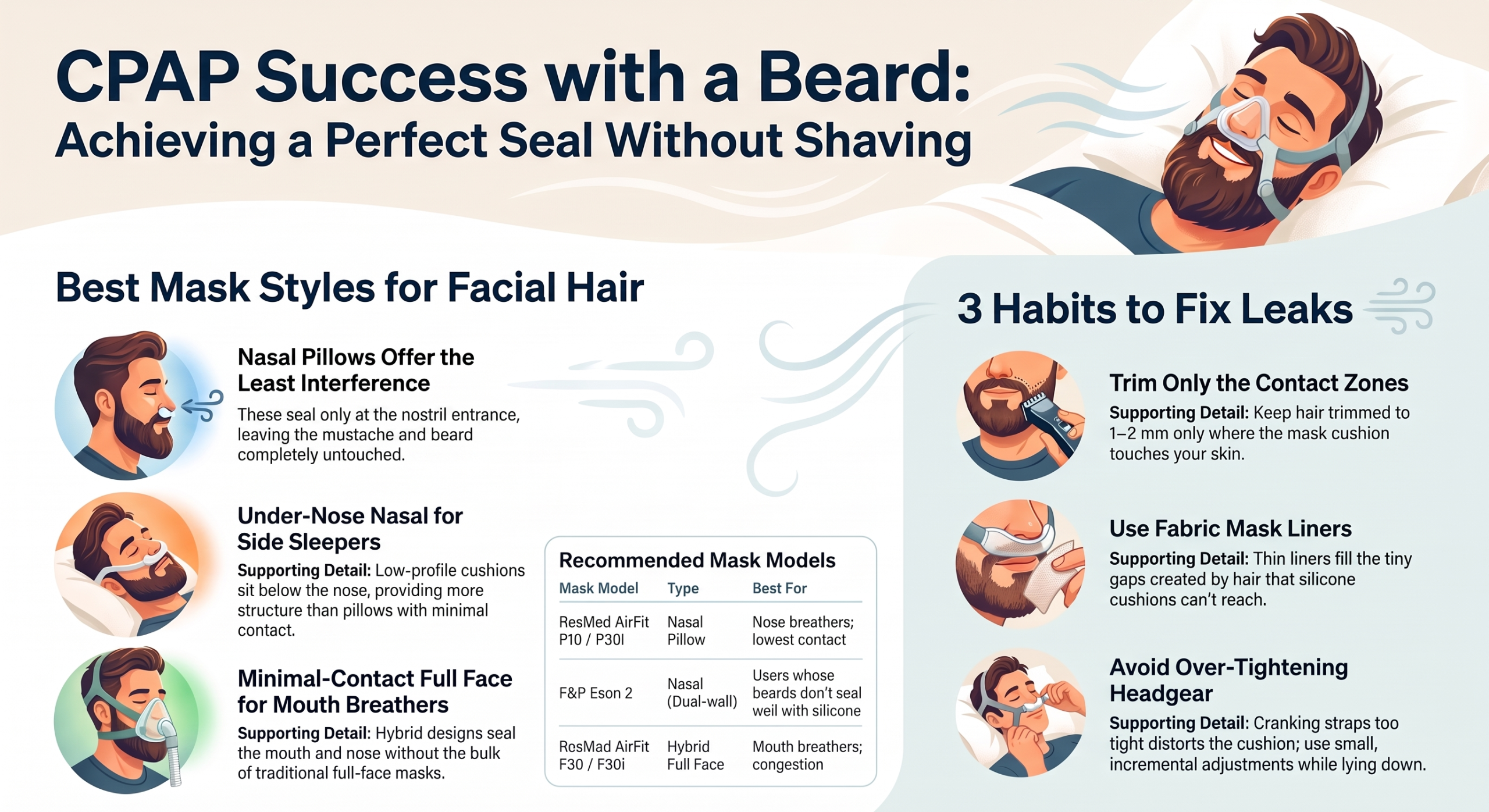
The best CPAP mask for beard users skips heavy contact with facial hair. That usually means nasal pillows, under-nose nasal masks, or minimal-contact full face designs. Models like the ResMed AirFit P10, N30i, F30i, and the Fisher & Paykel Eson 2 tend to seal better because there’s simply less cushion touching beard territory in the first place.
If you’re dealing with leaks, red pressure marks, or you’re half-convinced you’ll need to shave to make this work — you don’t. This guide walks through which mask styles actually hold a seal against facial hair, how a few small grooming changes fix most leaks, and which specific models are worth trying first. If you want the fuller picture of how nasal, nasal pillow, and full face styles compare in general before narrowing down by beard fit specifically, our nasal vs. nasal pillow vs. full face mask guide is worth reading first.
Best Mask Type for Facial Hair: Styles That Actually Seal Around a Beard
Not every mask style fights your beard the same amount. Here’s how the three main options stack up.
Nasal Pillows: Minimal Contact, Maximum Clearance
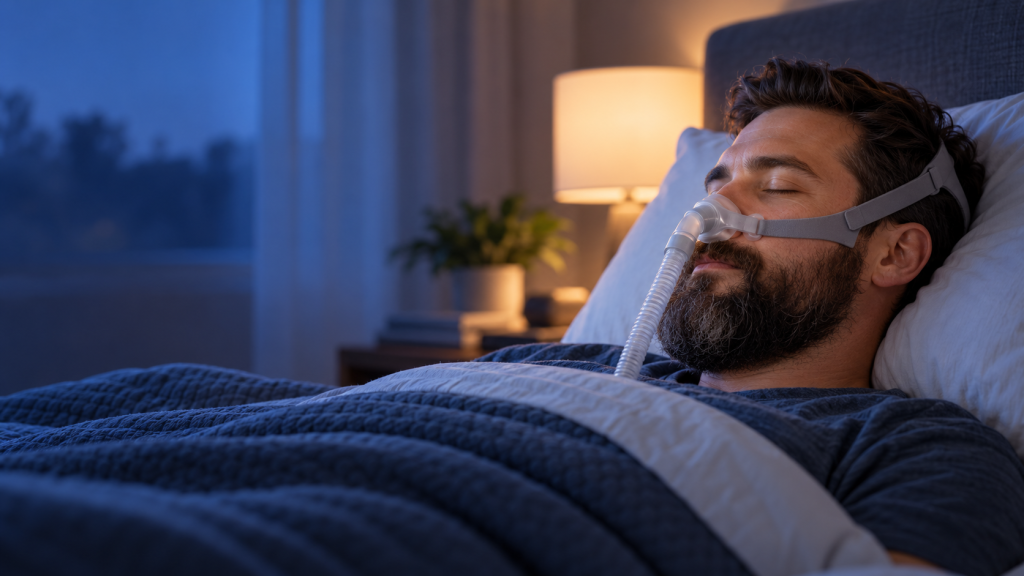
Nasal pillows are usually the first thing worth trying if you have a beard, because they only touch the inside of your nostrils. The mustache, chin, and cheeks stay completely untouched. Small silicone inserts — the ResMed AirFit P10 and P30i are the two most common — create their seal right at the nostril opening, so there’s nothing for your beard to interfere with.
This style works best if you’re a consistent nose breather. If your mouth tends to fall open at night, a chin strap solves that without giving up the pillow design. At higher pressures, some people notice nasal irritation, so fit still matters even with less material involved.
Under-Nose Nasal Masks: Open Feel, Low Beard Interference
Under-nose designs sit just below the nostrils instead of covering the whole nose, which clears the mustache and upper beard area entirely. The ResMed AirFit N30 and N30i use a low-profile cushion that seals right under the nose, leaving most of your face — and most of your beard — untouched.
Side sleepers and people who move around a lot tend to like this style. It gives a bit more structure than pillows without the bulk of a full nasal mask. The catch is the same as with pillows: you need reliable nose breathing, or mouth leak will undercut the seal.
Minimal-Contact Full Face and Hybrid Masks
Sometimes you genuinely need mouth coverage — heavy congestion, mouth breathing, whatever the reason. You don’t have to go back to a bulky traditional full face mask to get it. The ResMed AirFit F30/F30i and the AirFit X30i hybrid both use low-profile cushions that sit under the nose while still sealing the mouth, so there’s noticeably less beard contact than an older-style full face design.
The Fisher & Paykel Eson 2 is worth a look here too — it’s a nasal mask rather than full face, but its dual-wall cushion is built specifically to conform around facial hair rather than fight it, which is a genuinely different approach from ResMed’s minimal-contact strategy. Memory foam cushions, like the AirTouch F20, can also mold around a beard better than rigid silicone in some cases, though trimming the contact zone usually gets you further than switching materials alone.
Which Mask Fits Which Beard Situation? Quick Comparison
| Mask | Type | Beard Contact | Best For |
|---|---|---|---|
| AirFit P10 / P30i | Nasal pillow | Lowest | Nose breathers, minimal contact preference |
| AirFit N30 / N30i | Under-nose nasal | Low | Side sleepers, more structure than pillows |
| Eson 2 | Nasal (dual-wall cushion) | Beard-Adaptive | Users whose beard doesn’t respond well to silicone alone |
| AirFit F30 / F30i / X30i | Minimal-contact full face/hybrid | Medium | Mouth breathers, congestion |
| AirTouch F20 | Full face, memory foam | Medium | Sensitive skin, pressure-mark prone |
Shop Beard-Friendly CPAP Masks
You don’t have to guess which model to try first. A few real starting points:
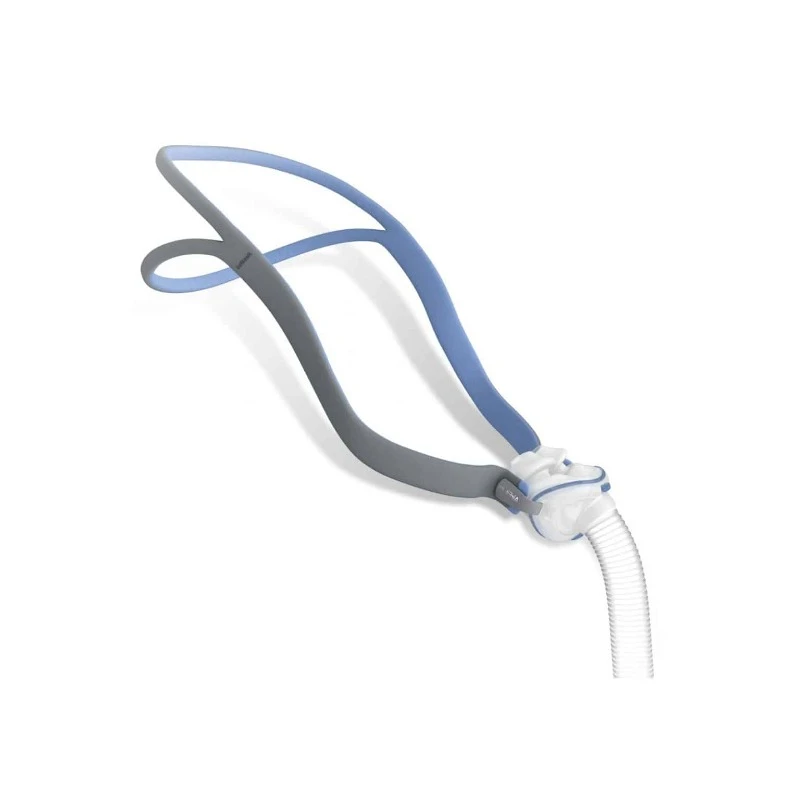
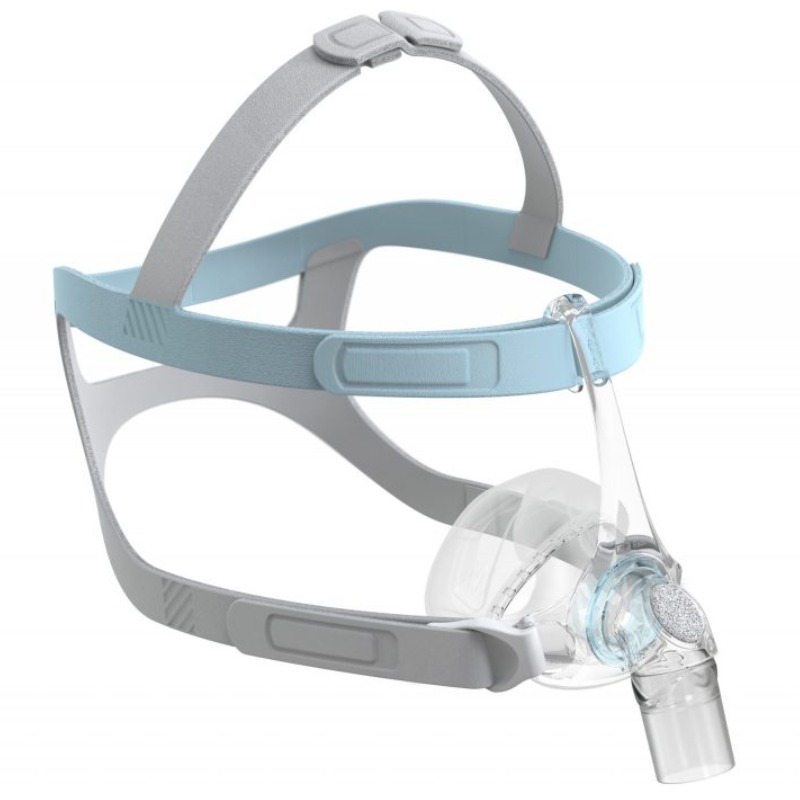
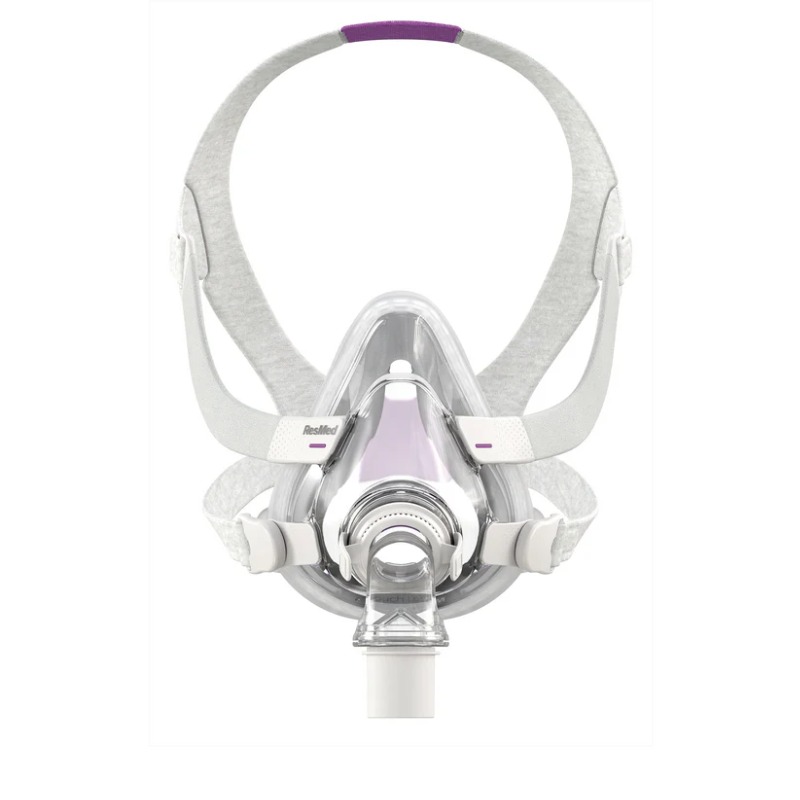
Browse the full range of CPAP masks if none of these three feel like the right fit for your specific beard and breathing pattern.
Grooming and Fit Tips for Bearded CPAP Users
Picking the right style solves most of the problem. These four habits close the rest of the gap.
Trim Contact Zones
You don’t need to shave anything. Keep the hair right where the cushion actually touches — the nose bridge, just below the nostrils for nasal masks, the upper lip line for full face masks — trimmed to about 1–2 mm. That’s usually enough for the cushion to seat properly while you keep the rest of your beard exactly as it is.
Clean Skin Before Bed
Oil and product buildup are sneaky leak causes. A quick wash with a gentle, non-oily cleanser right before your mask goes on gives the cushion a cleaner surface to grip.
Try a Mask Liner
Thin fabric liners sit between your skin and the cushion, filling in the tiny gaps facial hair creates. They’re inexpensive, and for a lot of bearded users, this single change fixes leaks that trimming alone couldn’t.
Adjust Gradually
The instinct when a mask leaks is to crank the straps tighter. With a beard, that usually backfires — it distorts the cushion instead of sealing it. Small, incremental adjustments while you’re lying in your actual sleep position work better than one big tightening session.
Watch: Minimal-Contact Mask Solutions
If claustrophobia or strap tension is part of your decision, watch how minimal-contact designs create a zero-drag seal:
Matching a Mask to Your Beard, Breathing, and Sleep Style
You’re a mouth breather and need real coverage. A minimal-contact full face or hybrid is your best bet — it seals both airways without the bulk of an old-school full face mask. The F30/F30i and X30i are strong starting points; their overhead hose routing also cuts down on drag. Nasal-only masks paired with a chin strap can work for mild mouth leak, but heavy congestion usually beats them.
You sleep on your side and hate hose drag. Look for anything with the “i” in its name — P30i, N30i, F30i — since these route the hose over the top of your head instead of the front. Combined with a low-profile cushion, that setup catches far less on your pillow and needs less strap tension to stay put.
Your current mask keeps leaking because of your beard. Before assuming you need a completely different brand, try moving one step toward less contact within the same family — a traditional nasal (N20) to an under-nose nasal (N30/N30i), or a standard full face (F20) to a minimal-contact one (F30/F30i). Testing a silicone AirFit cushion against a memory foam AirTouch cushion on the same frame is also worth doing before you buy anything new.
You just want one clear starting point. Nasal pillows (P10, P30i) give you the least beard contact. Under-nose nasal (N30, N30i, or the Eson 2) adds a bit more structure while staying open. Minimal-contact full face or hybrid (F30/F30i, X30i) is there if you need mouth coverage. Pick based on how you breathe and how much contact you’re willing to tolerate before you start comparing specific models. If claustrophobia is also part of your decision, our guide to CPAP masks for claustrophobia covers a lot of the same minimal-contact models from that angle.
Frequently Asked Questions
Do I need to shave my beard for a CPAP mask to seal properly?
What’s the best CPAP mask for men with beards?
Is the Fisher & Paykel Eson 2 good for beards?
Why does my CPAP mask leak more since I grew a beard?
Do mask liners actually help with beard-related leaks?
Can I use a full face CPAP mask if I have a thick beard?
Which ResMed mask has the least contact with a beard?
Resources & Further Reading: American Academy of Sleep Medicine