Table of Contents
Quick answer: ResMed AirFit masks compared side by side come down to three families — full face (F20, F30, F30i, F40, X30i) for mouth breathers, nasal (N20, N30, N30i) for steady nose breathers, and nasal pillow (P10, P30i) for minimal contact. Pick by breathing route, sleep position, and pressure need.
If you’re choosing between two ResMed mask lines, confused by overlapping model names, or dealing with skin irritation from silicone, this guide breaks down the full AirFit lineup in plain language — including which models suit side sleepers and when memory foam (AirTouch) may be a better fit than silicone.
Not sure which one is yours? Use the decoder below before you read the model details — it makes every name make sense instantly.
Decoding ResMed AirFit Names: F, N, P, X and the Numbers
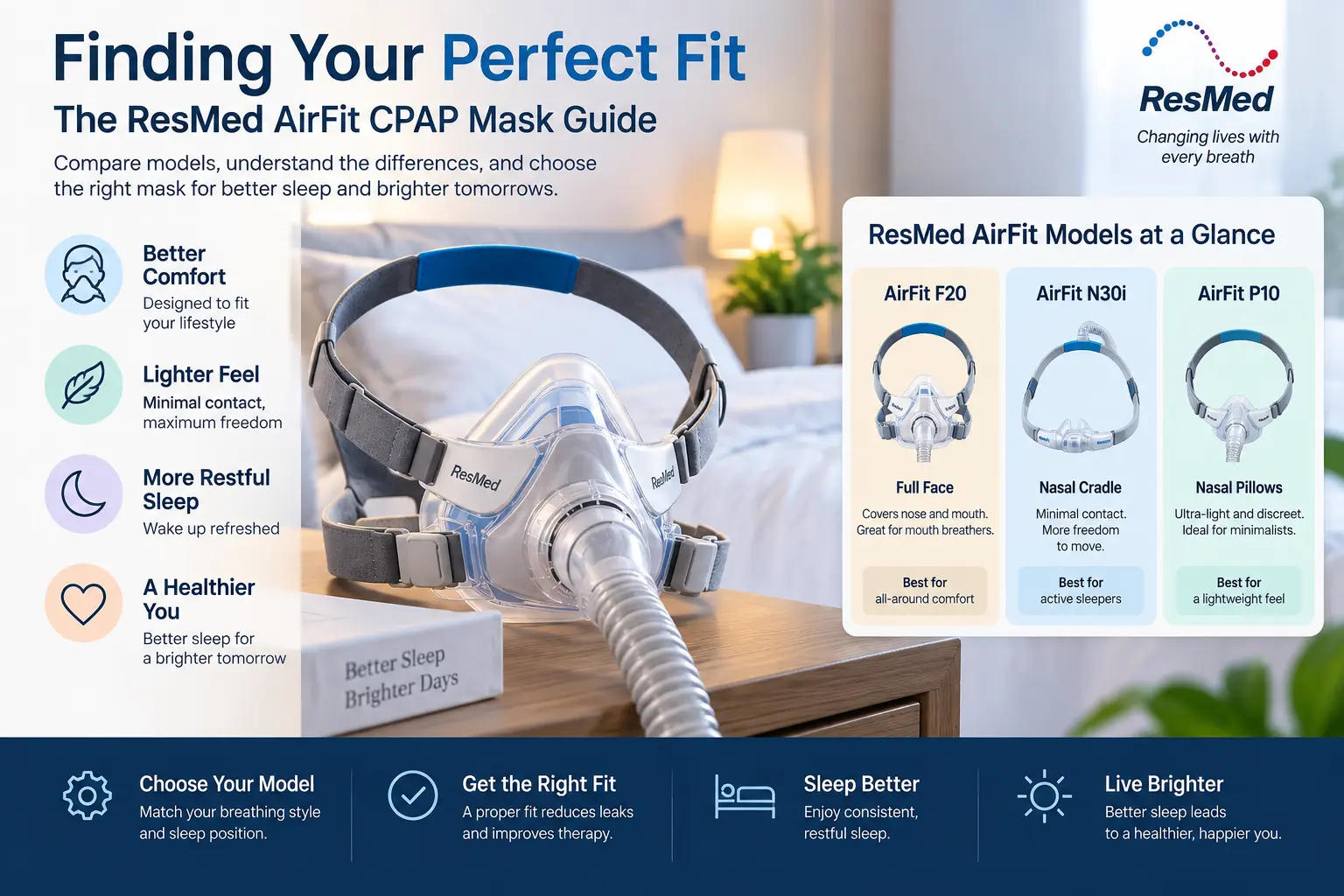
ResMed naming looks complicated, but the pattern is simple once you see it:
- F = Full face (nose + mouth) · N = Nasal (nose only) · P = Pillow (nostrils only) · X = Oral-nasal hybrid
- 20 = Traditional, full-coverage design · 30 = Minimal-contact, sits under the nose · 40 = Side-sleeper optimized
- “i” suffix = Tube routes over the top of the head instead of the front, cutting hose drag (e.g., F30i, N30i, P30i)
So an N30i is a nasal mask, minimal contact, with top-of-head tubing. Once you know your breathing route and whether hose drag bothers you, the right code becomes obvious. Keep this in mind as you read the models below.
AirFit Mask Comparison Table
Here are ResMed AirFit masks compared at a glance, before the model-by-model detail below:
Model | Type | Coverage | Hose routing | Best for |
F20 | Full face | Nose + mouth, traditional | Front | Mouth breathers, back sleepers, high pressure |
F30 | Full face | Under-nose, minimal contact | Front | Mouth breathers who want a lighter feel |
F30i | Full face | Under-nose, minimal contact | Top-of-head | Mouth breathers who are active/side sleepers |
F40 | Full face | Low-profile, side-sleeper design | Front | Mouth breathers who sleep on their side |
X30i | Oral-nasal hybrid | Mouth + under-nose | Top-of-head | Mouth coverage without nose-bridge pressure |
N20 | Nasal | Whole nose | Front | Steady nose breathers, side sleepers |
N30 | Nasal | Under-nose | Front | Active sleepers, glasses wearers |
N30i | Nasal | Under-nose | Top-of-head | Active/side sleepers wanting minimal drag |
P10 | Nasal pillow | Nostrils only | Front | Stomach sleepers, travelers, claustrophobia |
P30i | Nasal pillow | Nostrils only | Top-of-head | Side sleepers wanting the lightest contact |
Full Face Models: F20, F30, F30i, F40, X30i
Full face AirFit masks cover both nose and mouth, making them the top choice for mouth breathers and users with frequent congestion. The AirFit F20 is the classic full face design with a traditional frame and InfinitySeal silicone cushion that provides a secure, durable seal. It suits back sleepers and users who want a proven, stable fit at moderate to high pressures.
The AirFit F30 and F30i are minimal-contact full face masks with cushions that sit under the nose, leaving the bridge free for glasses and reading. The F30 has a front hose connection, while the F30i routes the tube over the top of the head, reducing hose drag for active and side sleepers.
The AirFit F40 is designed with side sleepers in mind, offering low facial contact and a stable seal even when turning. The AirFit X30i is an oral-nasal hybrid that covers the mouth and sits under the nose, combining full face therapy with minimal upper-face contact — useful if you need mouth coverage but dislike nose-bridge pressure.
Ready to compare these in stock? Browse ResMed full face masks at cpapRX to see current sizes and pricing.
Nasal Models: N20, N30, N30i
Nasal AirFit masks cover only the nose, leaving the mouth free for a less confined feel. The AirFit N20 is a popular nasal mask with an InfinitySeal silicone cushion that conforms to the nose for a stable seal — a strong choice for side sleepers who want more coverage than pillows but less bulk than full face.
The AirFit N30 and N30i are under-nose nasal masks with cushions that sit below the nostrils, keeping the bridge clear. The N30 has a front hose connection, while the N30i routes the tube over the top of the head for minimal drag — both suit active sleepers, glasses wearers, and anyone who wants a light, open feel with reliable nasal therapy.
See how these fit your face shape: browse ResMed nasal masks at cpapRX.
Nasal Pillow Models: P10, P30i
Nasal pillow AirFit masks use small silicone inserts at the nostril entrance for minimal facial contact. The AirFit P10 is one of the lightest CPAP masks available, with a compact frame and front hose connection — ideal for stomach sleepers, travelers, and users who feel claustrophobic in larger masks.
The AirFit P30i is a nasal pillow mask with top-of-head hose routing, eliminating hose drag across the face and pillow — an excellent option for side sleepers who want the lightest possible contact with a stable seal.
Silicone Irritation? When AirTouch (Memory Foam) Might Fit Better
If you experience skin irritation with silicone cushions, the AirTouch line (memory foam or fabric) may be more comfortable. AirTouch F20 and N20 use UltraSoft memory foam that conforms gently to facial contours, reducing pressure marks and redness. The AirTouch N30i uses a ComfiSoft fabric cushion that combines softness with breathability.
Because AirFit and AirTouch share the same frames within each model, you can often swap cushions on the same mask to test both materials before committing. For the full breakdown of silicone versus memory foam — including cost and cleaning differences — see our ResMed AirFit vs AirTouch comparison.
How Often Should You Replace a ResMed AirFit Mask?
Even the right mask stops sealing well if the parts are worn, so replacement timing matters as much as the model you pick. As a general guide:
- Cushions: replace roughly every 1–3 months, sooner if the silicone looks flattened, sticky, or cracked
- Headgear: replace roughly every 6 months, or when the fabric loses elasticity
- Full mask frame: typically every 6–12 months with regular cleaning
- CPAP filters (machine side): disposable filters roughly every 1–2 weeks to monthly depending on your machine; reusable filters every 6 months
These are general manufacturer guidelines — your insurance plan may have its own replacement schedule, and signs like persistent leaks or skin marks mean it’s time sooner regardless of the calendar. If your current cushion isn’t sealing properly, browse replacement AirFit cushions and parts rather than assuming the whole mask has failed.
Which AirFit Mask Fits Your Situation?
With ResMed AirFit masks compared across three families, most people find their answer by starting from one of these situations:
Mouth breather, unsure if a nasal-only mask will work — A full face AirFit mask is usually most effective because it seals both airways. The F20, F30, F30i, F40, or X30i are all strong options depending on how much facial contact you want to avoid.
Side sleeper who wants minimal hose drag — Masks with top-of-head hose connections cut drag and leaks when turning. The F30i, N30i, and P30i are built for this; the F40 and N20 also work well thanks to their low-profile cushions.
Two mask lines offered by your DME, can’t decide — If one option is AirFit and the other AirTouch, the honest answer is: AirFit (silicone) for durability and easy washing, AirTouch (memory foam) for plush comfort and sensitive skin. Since frames are cross-compatible, ask if you can trial both cushions on one frame before choosing.
FAQ's
What’s the difference between AirFit and AirTouch masks?
AirFit masks use silicone InfinitySeal cushions that are durable and fully washable, typically lasting up to 90 days. AirTouch masks use UltraSoft memory foam or ComfiSoft fabric cushions that conform gently for plush comfort but require wipe-only cleaning and replacement roughly every 30 days.
Which ResMed AirFit mask is best for side sleepers?
The AirFit F30i, N30i, and P30i are best for side sleepers because their top-of-head hose routing reduces drag and leaks when turning. The F40 and N20 are also strong options thanks to their low-profile cushions that catch less on the pillow.
Do AirFit and AirTouch masks fit the same headgear?
Yes, AirFit and AirTouch share the same frame and headgear within each model type, such as F20 or N20. This means you can swap a silicone AirFit cushion for a memory foam AirTouch cushion on the same frame without buying a whole new mask.
How often should I replace my ResMed AirFit mask cushion?
Replace AirFit silicone cushions roughly every 1–3 months with proper cleaning, sooner if they look flattened, sticky, or cracked. Headgear typically lasts about 6 months, and the full frame around 6–12 months, though persistent leaks are a sign to replace parts earlier regardless of schedule.
Which AirFit model is best for mouth breathers?
A full face AirFit mask is best for mouth breathers since it seals both the nose and mouth. The F20, F30, F30i, F40, and X30i all work well, differing mainly in facial contact and hose routing rather than effectiveness for mouth breathing.
What does the “i” mean in ResMed mask names like F30i or N30i?
The “i” suffix means the hose routes over the top of the head instead of connecting at the front of the mask. This reduces hose drag and tangling for side sleepers and anyone who moves a lot during the night.
Is AirTouch more expensive than AirFit over time?
Yes, typically. AirTouch memory foam cushions are usually replaced about every 30 days, while AirFit silicone cushions last up to 90 days, making AirFit more cost-effective long-term even if the plush comfort of AirTouch is worth it for sensitive skin.
Can I try both AirFit and AirTouch cushions before deciding?
In most cases, yes. Because AirFit and AirTouch share compatible frames within the same model, you can test both a silicone and a memory foam cushion on one mask before committing to a full purchase, which is the easiest way to settle a comfort preference.
The Bottom Line
When you get ResMed AirFit masks compared side by side, the decision really comes down to three questions: how you breathe, how you sleep, and how much facial contact you’re willing to tolerate. Full face models solve mouth breathing, “i” models solve hose drag for side and active sleepers, and pillows solve minimal contact — with AirTouch as the comfort upgrade if silicone irritates your skin. Match those three answers to the table above, and the right model becomes obvious.
Ready to order or compare current stock and pricing? Shop ResMed AirFit and AirTouch masks at cpapRX — every mask ships with a trial period so you can confirm the seal and comfort before committing.
Resources & Further Reading
Medical Disclaimer: This article is for general education only and is not medical advice. CPAP masks are part of prescription therapy — your pressure settings and mask fit should be confirmed with a qualified sleep specialist.